

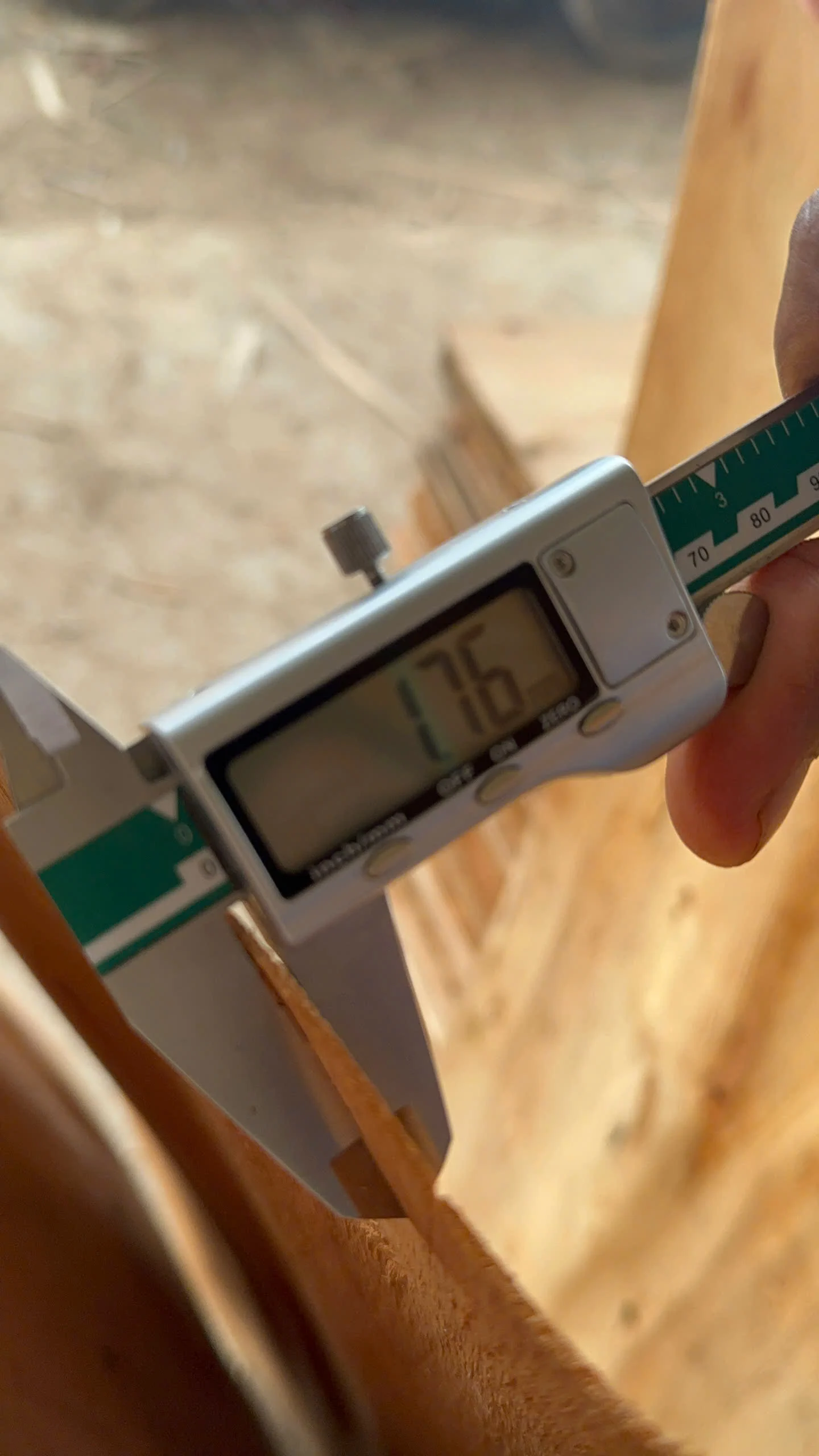
The single most common specification error buyers make when ordering Vietnam plywood: confusing formaldehyde emission classes (E0, E1, E2) with glue types (Melamine/MR, Phenolic/WBP). They are completely separate specifications. A panel can carry E0 emission rating with either melamine or phenolic glue. Mixing them up leads to wrong specs, failed tests, and rejected shipments.
This guide covers the E0, E1, E2 plywood formaldehyde emissions classes in full — explained clearly with exact limits, test methods, and which Vietnam plywood emission standards apply to each target market.
📋 What Are Formaldehyde Emission Ratings?
Formaldehyde emission class: A certification that limits how much formaldehyde gas a finished plywood panel releases into surrounding air over time.
Formaldehyde is a natural byproduct of the adhesive resins used in plywood production — primarily urea-formaldehyde (UF) and melamine-formaldehyde (MF) resins. All wood-based panels release some formaldehyde. The emission classes define the acceptable ceiling for indoor use.
| Class | Formaldehyde Limit | Test Standard | Market |
|---|---|---|---|
| E0 | ≤0.5 mg/L (desiccator) | EN 717-2 / JIS | Japan, Korea, EU premium, US (≈ CARB P2) |
| E1 | ≤1.5 mg/L (desiccator) | EN 717-2 | EU standard, most Asian markets |
| E2 | ≤5.0 mg/L (desiccator) | EN 717-2 | Industrial/exterior, banned for EU interior use |
⚠️ Important: E2 class plywood is not permitted for indoor residential or commercial use in the European Union, United States, Japan, or South Korea. Using E2 panels in furniture destined for these markets exposes buyers to regulatory and liability risk.
The emission class is stamped on the panel edge or declared in the test report. It must match the order specification exactly.
📊 E0 — Ultra-Low Emission for Premium Markets
E0 is the strictest formaldehyde class in the European EN standard system. At ≤0.5 mg/L, it delivers indoor air quality equivalent to natural solid wood.
Markets that require E0:
- Japan (JAS F4-star standard ≈ E0)
- South Korea (furniture-grade interior panels)
- Germany, Scandinavia (premium furniture manufacturers)
- United States high-end residential furniture (alongside CARB P2)
How Vietnam factories achieve E0:
Two routes are available in practice:
-
Low-emission melamine resin (MF) — Furniture-grade factories reformulate the MF resin blend to reduce free formaldehyde content. Combined with precise hot-press temperature (140-150°C) and time cycles, E0 is achievable. HCPLY’s premium furniture facility produces E0-certified panels using this method (HCPLY production data, 2026).
-
Phenolic resin (WBP) — Phenolic resin chemistry inherently produces very low free formaldehyde. Film-faced and construction panels using WBP glue typically achieve E0 emission levels without reformulation.
💡 Key Insight: Achieving E0 with melamine glue requires Grade A raw materials, calibrated press parameters, and consistent veneer moisture (target 6-8%). Budget commercial factories running acacia core with loose-laid construction cannot reliably hit E0 — the resin mix and press control are insufficient.
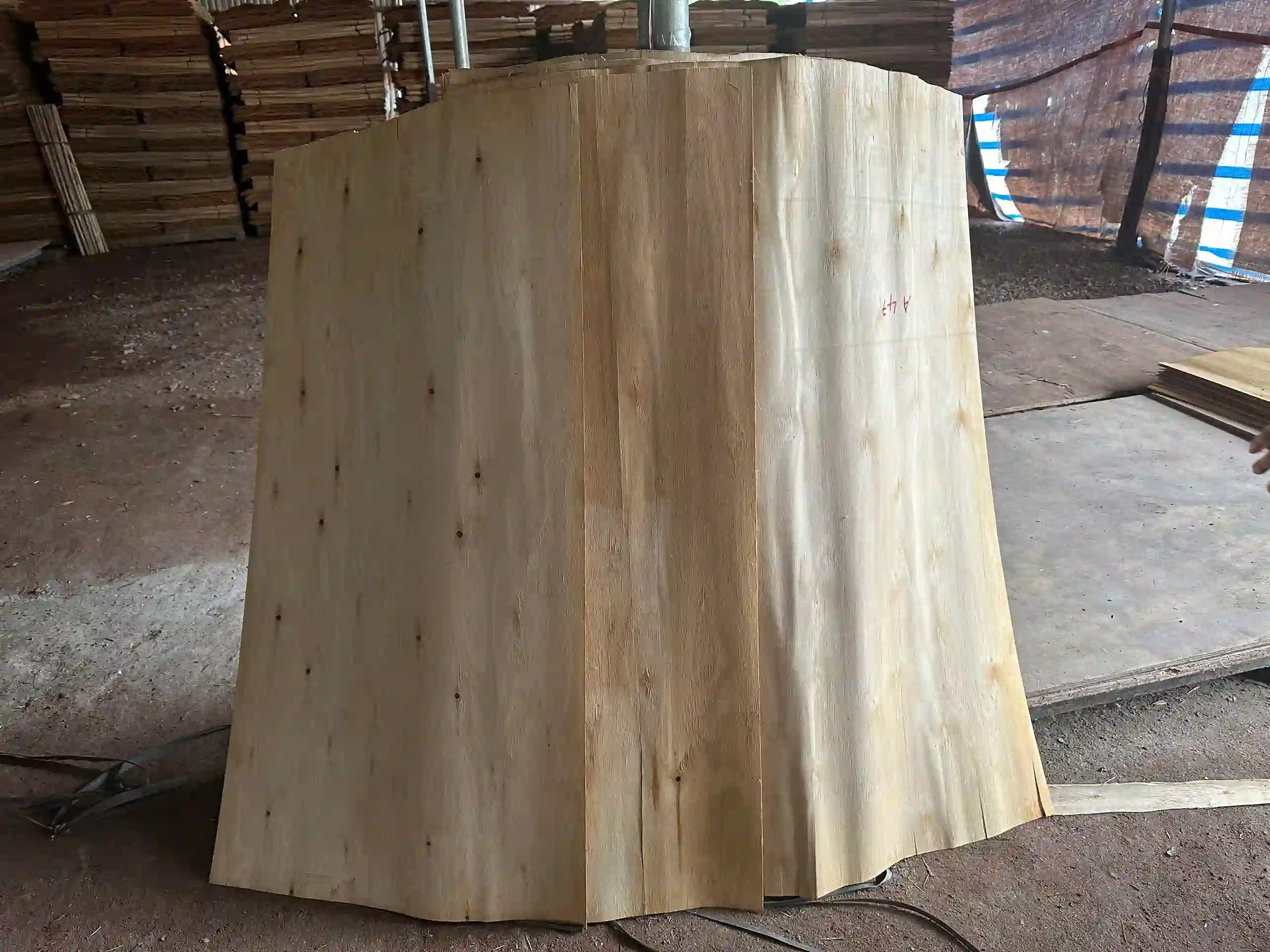
E0 panels carry a measurable cost premium — roughly 8-15% above equivalent E1 product, depending on resin grade and volume. For furniture destined for Japan or Korea, this is non-negotiable.
“For buyers sourcing furniture-grade plywood for Japan or Korean markets, E0 documentation must accompany every shipment. We build this into the order specification from day one, not as an afterthought.” — Lucy, International Sales Manager, HCPLY
📊 E1 — The Standard Indoor Grade
E1 at ≤1.5 mg/L is the baseline indoor-safe standard across most export markets. It is the minimum required for any plywood used inside buildings in the European Union (EN 13986 for construction products).
Markets that accept E1:
- European Union (standard grade — minimum for interior use)
- Australia, New Zealand (AS/NZS 2269 construction panels)
- India, UAE, Southeast Asia (furniture and commercial)
- Most Middle East markets
Production in Vietnam:
E1 is the most common emission class produced by Vietnamese furniture-grade factories. Standard melamine resin (MF) with controlled press parameters reliably delivers E1. Acacia or eucalyptus core construction does not impede E1 achievement — the resin chemistry and press control are the primary variables.
For mixed orders spanning multiple products, E1 is the practical default specification when individual panel emission requirements are not stated.
💡 Key takeaway: Specifying “E1 or better” as a floor for all your plywood orders is a safe baseline for most global markets. It excludes E2 packing-grade material from accidentally entering interior-use products.
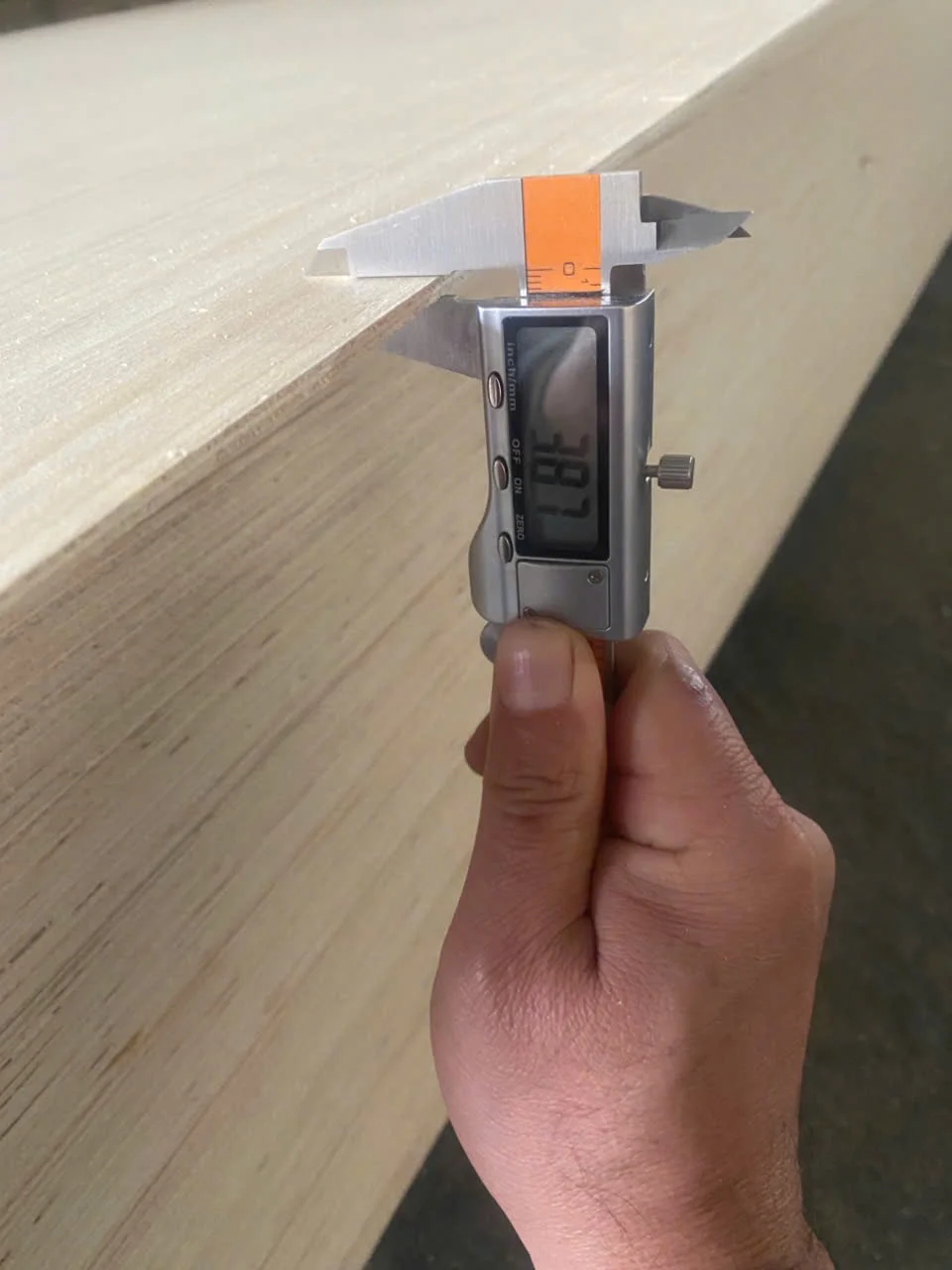
📊 E2 — Industrial and Exterior Grade Only
E2 at ≤5.0 mg/L covers panels where indoor air quality is not a concern: industrial packaging, pallet crates, exterior hoarding, temporary construction shuttering where WBP glue is not used.
Applications where E2 is acceptable:
- Export crates and wooden pallets (ISPM-15 fumigated)
- Temporary site hoardings in markets without indoor standards
- Industrial packaging for non-food goods
Where E2 is NOT acceptable:
- Any panel used inside a building (EU, US, Japan)
- Furniture destined for CARB P2 markets (US)
- Construction products sold in the EEA (CE mark requires minimum E1)
Vietnamese packing-grade factories default to E2 or even unclassified panels when no emission spec is declared. For buyers mixing packing and furniture orders in the same container, explicit emission class must be stated per product line — otherwise the factory may ship packing-grade resin across the entire order.
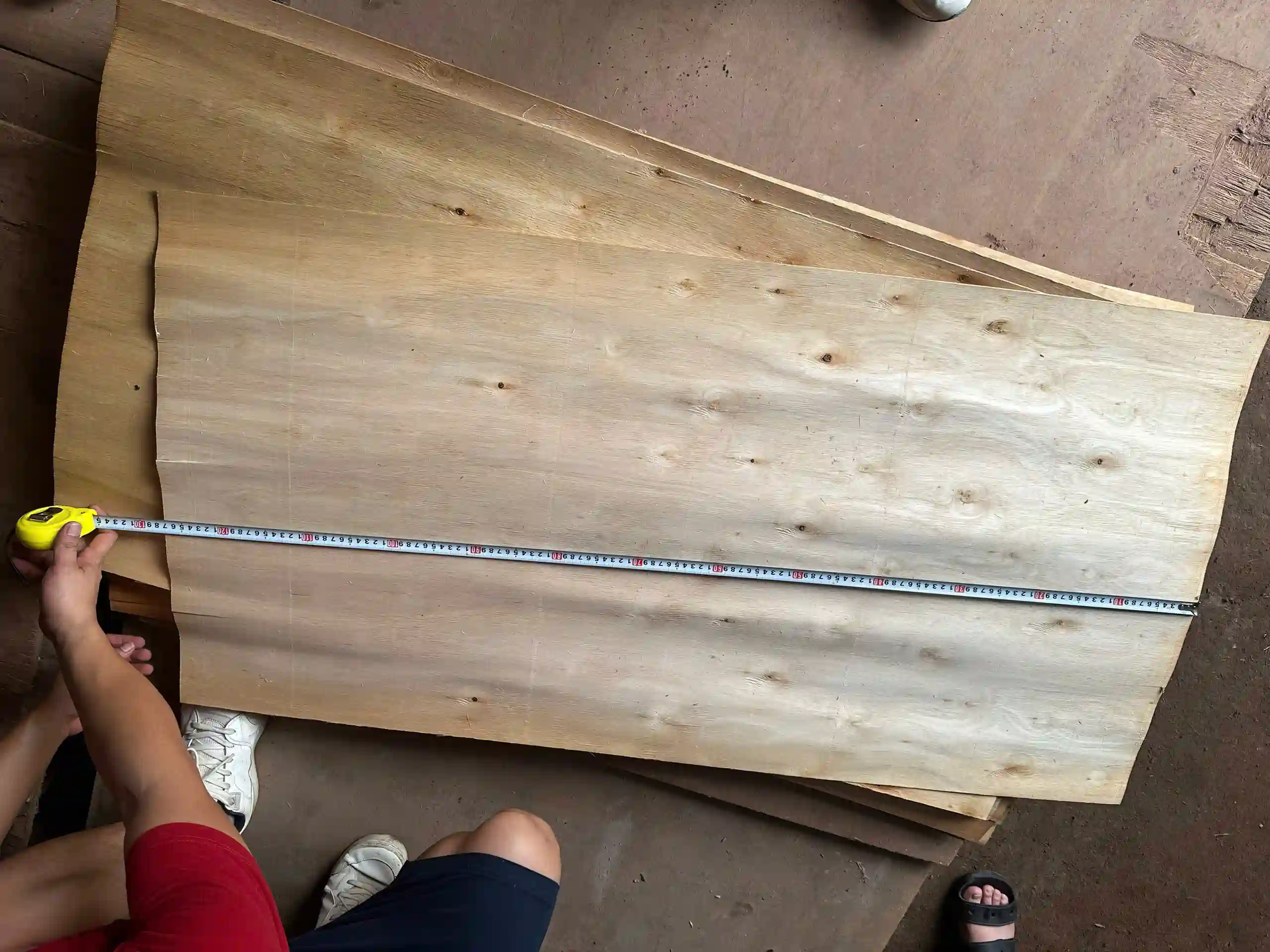
🔧 Test Methods: How Emission Class Is Measured
Two test methods are used across global standards. Understanding which applies to your target market prevents specification mismatch.
📌 Desiccator Method (EN 717-2)
Used in: European EN standards (E0, E1, E2 classification)
Small panel samples are placed inside a sealed desiccator vessel. Formaldehyde gas released over 24 hours is absorbed by distilled water. The water is then analyzed by spectrophotometry to measure mg/L concentration.
- E0: ≤0.5 mg/L
- E1: ≤1.5 mg/L
- E2: ≤5.0 mg/L
📌 Perforator Method (EN 120)
Used in: European factories (older standard, still referenced)
Panel samples are extracted using methanol solvent under heat. Formaldehyde is measured in mg per 100g of oven-dry panel. Limits: E1 ≤8 mg/100g, E2 ≤30 mg/100g.
📌 Air Chamber Method (ASTM E1333 / CARB)
Used in: United States CARB P2 standard
Full-size panels are tested in a climate-controlled chamber. Formaldehyde concentration is measured in parts per million (ppm) of room air after equilibration.
- CARB P2 hardwood plywood: ≤0.05 ppm
This is functionally equivalent to E0 but uses a different test apparatus. For a detailed comparison of these two standards, see E0 vs CARB P2 emission standard differences. When importing into the US, request the CARB P2 test report specifically — an EN E0 report is not automatically accepted by CARB.
📦 Emission vs. Glue Type — The Critical Distinction
This distinction prevents the most common specification error in plywood sourcing:
| Specification | Controls | Standard Examples |
|---|---|---|
| Glue type | Water resistance of the bond | Melamine (MR, 12h boil) / Phenolic (WBP, 72h boil) |
| Emission class | Formaldehyde gas released | E0 / E1 / E2 / CARB P2 / JAS F4 |
These are independent axes. Every combination exists in practice:
- Phenolic WBP + E0 → film-faced construction plywood for EU markets
- Melamine MR + E0 → premium furniture plywood for Japan
- Melamine MR + E1 → standard furniture plywood for EU
- Melamine MR + E2 → packing and commercial plywood for price-sensitive markets
The correct specification format for a purchase order is:
Glue: Melamine (MR) | Emission: E0Not: "E0 glue" or "MR E0" — these mixed notations create ambiguity in the factory order and in the export documentation.
For deeper coverage of glue types and their boiling test standards, see our plywood glue types and emission standards guide.
🌍 Emission Standards by Market
Buyers from different regions face different regulatory requirements. The table below maps target markets to their mandatory emission standards as of 2026.
| Market | Minimum Standard | Regulatory Basis |
|---|---|---|
| United States | CARB P2 (≤0.05 ppm) | California Air Resources Board; applies nationwide for TSCA Title VI |
| European Union | E1 minimum (construction) | EN 13986; E2 banned for indoor use |
| Japan | JAS F4-star (≈ E0) | Ministry of Land, Infrastructure, Transport and Tourism |
| South Korea | SE0 or E0 equivalent | Korean Industrial Standards KS F 3101 |
| India | No federal standard; BIS IS 303 covers grades but not emission | E1 recommended for premium furniture |
| UAE / Middle East | E1 common for quality imports; E2 for construction | No unified standard; buyer-driven |
| Australia | E1 via AS/NZS 2269 for structural | E0 for interior furniture increasingly demanded |
For US-bound shipments, review our full CARB P2 plywood guide for the US market covering documentation requirements and third-party certification.
For EU buyers, FSC certification and EUDR compliance are increasingly bundled with E1/E0 emission requirements. See the plywood certifications and export documentation guide for the complete documentation checklist.
✅ How to Specify Emission Class in Your Order
A clear purchase order prevents emission-class disputes at destination port. Include these four fields:
- Emission class: State E0, E1, or CARB P2 explicitly
- Test method: EN 717-2 (desiccator) or ASTM E1333 (chamber)
- Documentation: Request factory test report with lot number
- Third-party option: Specify SGS/BV/Intertek pre-shipment test for high-value orders
For furniture exports to Japan, additionally request the JAS F4-star stamp or equivalent test report, as Japanese customs accept JAS certification directly.
⚠️ Note: “Low formaldehyde” or “eco-friendly” without an emission class code is meaningless in a purchase order. Always state E0, E1, or CARB P2 with the specific test standard.
🏭 Vietnam Factory Emission Capabilities
| Facility | Core Species | Glue | Emission | Market |
|---|---|---|---|---|
| Premium furniture | Styrax, Eucalyptus | Melamine (MF) | E0 / CARB P2 | EU, US, Japan, Korea |
| Commercial / packing | Acacia | Melamine (MF) | E1 / E2 | India, Middle East, SEA |
| Premium film-faced | Eucalyptus, Acacia | Phenolic (WBP) | E0 (inherent) | EU, Korea, Australia |
Every HCPLY order includes a factory emission test report as standard documentation. Third-party lab tests can be arranged on request for large volume orders (Bureau Veritas, SGS). Factory-direct documentation means no intermediary repackaging the certification chain (HCPLY production data, 2026).
Request E0-Certified Plywood Samples — Factory-direct pricing, test reports included, MOQ 1 × 40HC.
📊 Emission Class and Panel Price — What to Expect
Emission class adds measurable cost to the finished panel. As of 2026, approximate FOB Hai Phong price differentials for furniture-grade birch-face plywood (18mm, 1220×2440):
| Emission Class | Relative Price Index | Notes |
|---|---|---|
| E2 | Base | Standard packing/commercial resin |
| E1 | +5-10% | Standard melamine furniture grade |
| E0 | +12-20% | Low-emission MF resin, premium press control |
| CARB P2 | +15-22% | CARB P2 certification fee + US-grade resin |
Exact FOB prices depend on core species, thickness, and order volume. Contact HCPLY for current quotation. These are directional ranges based on production cost structure, not guaranteed pricing.
❓ Frequently Asked Questions
Does phenolic WBP glue always achieve E0 emission?
Phenolic resin inherently produces less free formaldehyde than urea-melamine resin due to its molecular cross-linking structure. Most WBP-glued panels achieve E0 class, but this depends on resin quality. Request a test report — do not assume E0 solely from WBP labeling.
Can emission class degrade over time?
Formaldehyde emission decreases as panels age — fresh-cut or just-pressed panels have higher emission rates. Panels in service for 6+ months typically show significantly lower readings. For import testing, this means sampling from fresh production batches most accurately reflects the emission class.
What is JAS F4-star?
JAS F4-star is the Japan Agricultural Standards (JAS) system’s highest emission class, equivalent to ≤0.3 mg/L under the desiccator method. It is stricter than European E0 (≤0.5 mg/L). Vietnamese factories producing for Japan must meet this tighter threshold. Request the JAS-specific test report, not just an E0 certification.
Is CARB P2 certification valid in Europe?
No. CARB P2 and European E1/E0 use different test methods. A CARB P2 report does not substitute for EN 717-2 documentation in European markets. Buyers shipping to both US and EU must maintain separate test reports per standard.
✅ Summary
Understanding E0, E1, E2 plywood emission classes is essential for compliant sourcing from Vietnam. Vietnam plywood emission standards vary by facility and order specification — not by factory default. The three classes:
- E0: ≤0.5 mg/L — for Japan, Korea, premium EU, US equivalent (CARB P2)
- E1: ≤1.5 mg/L — standard EU and Asian markets baseline
- E2: ≤5.0 mg/L — industrial/exterior only, banned for indoor use in EU/US/Japan
Always specify emission class separately from glue type. For deeper technical detail on how E0, E1, and E2 interact with CARB P2 in practice, see our E0 E1 E2 CARB P2 emission standard comparison. Request factory test reports with every shipment. For US-bound orders, verify CARB P2 specifically — E0 certification does not automatically satisfy CARB requirements.
HCPLY produces across all three emission classes from dedicated facilities, with factory-direct documentation and third-party lab testing available on request.
Disclosure: This article is published by HCPLY, a Vietnam-based plywood manufacturer and export operator. While we aim to provide objective industry guidance, readers should consider our perspective as a market participant when evaluating recommendations.
Get a Free Quote with E0 or CARB P2 Certification — State your target market and we confirm the emission standard in writing before production.