





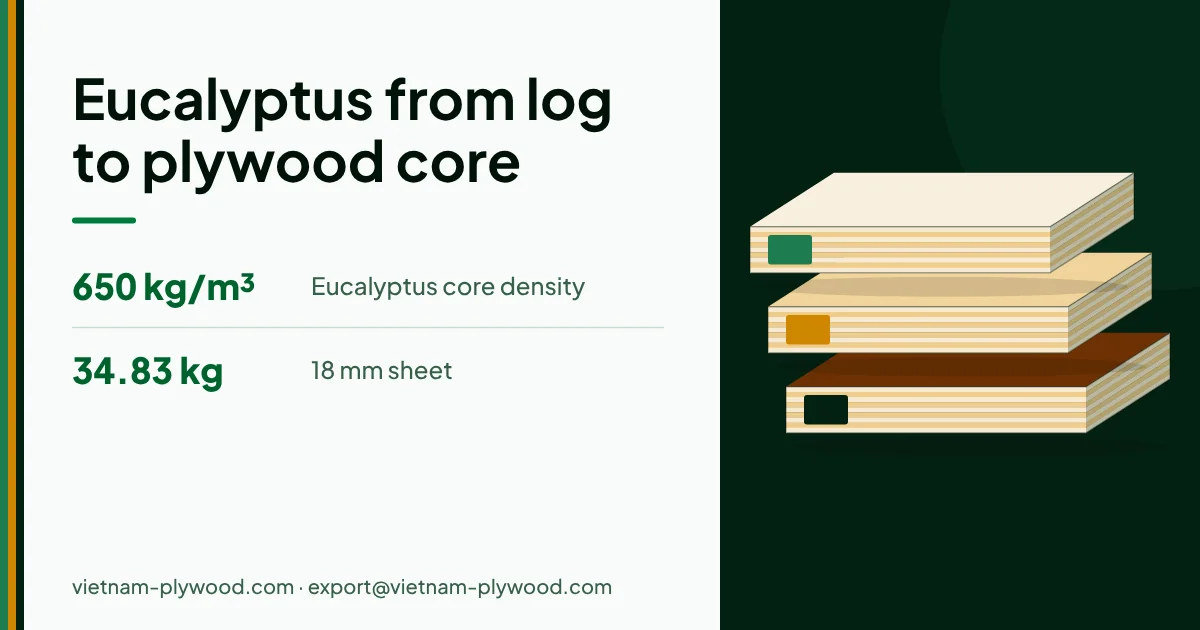
Eucalyptus wood is a plantation hardwood used in Vietnamese plywood cores and faces, with core density and veneer quality shaping the final panel. Choosing the wrong core or glue can add freight cost, delay approval or cause a rejected load. At HCPLY, the buying decision starts with the intended use and the producing line, rather than a timber name alone.
Is eucalyptus wood a hardwood?
Eucalyptus wood is a botanical hardwood because eucalyptus trees are flowering broadleaf trees. That classification does not establish a plywood panel’s bending strength, bond durability or permitted structural use. For importers, the useful distinction is between the species of timber, the construction of its veneers and the finished panel specification.
The name covers numerous species and hybrids, including Eucalyptus grandis. Eucalyptus grandis timber is used for different wood products, but its properties cannot stand in for every eucalyptus species. Solid eucalyptus lumber hardness figures also cannot be transferred directly to a cross-laminated plywood panel. A face called eucalyptus and a core made from eucalyptus describe different components. HCPLY names a faced product by its face veneer; core species remains a separate purchase-order field.
How dense is eucalyptus wood in our plywood?
Our eucalyptus core reference density is 650 kg/m³, compared with 580 kg/m³ for acacia and 500 kg/m³ for styrax. These are core-based planning figures for our panel builds; they are not universal values for every eucalyptus tree. A eucalyptus face over a styrax core follows the styrax core density for the loading calculation.
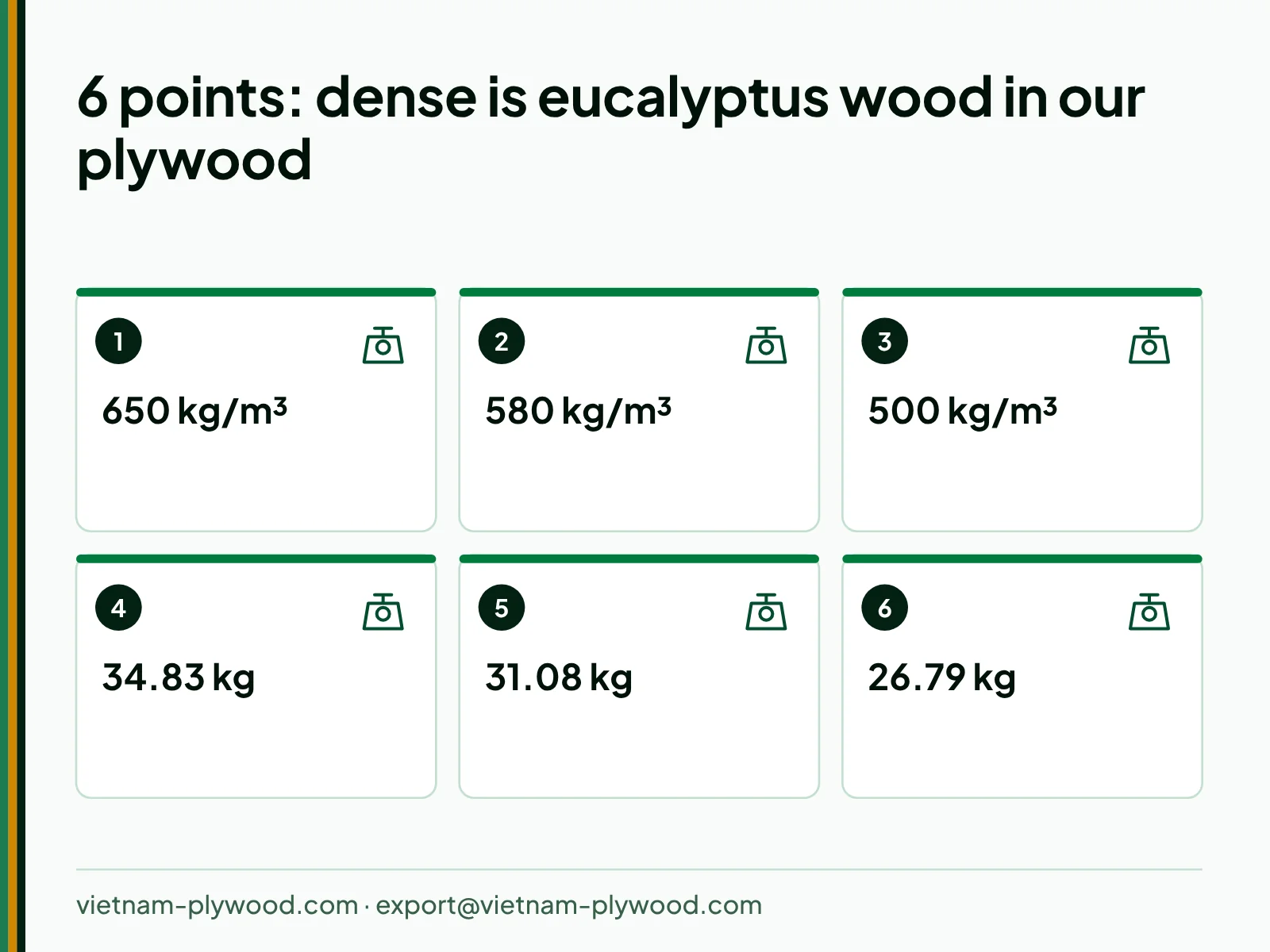
For an 18 mm, 1220 × 2440 mm sheet, the corresponding weights are 34.83 kg for eucalyptus, 31.08 kg for acacia and 26.79 kg for styrax. This changes handling, freight planning and the sheet count a buyer can allocate to a container. A US Forest Service-hosted 2017 study of young Eucalyptus grandis × Eucalyptus urophylla plantation trees evaluated specific gravity and moisture content; it illustrates why species, age and measurement conditions matter when discussing wood density (US Forest Service, 2017).
What does a eucalyptus core change across our three lines?
A eucalyptus core is an option on our furniture line and our construction line. Our commercial and packing line uses acacia core. The same nominal 18 mm order therefore requires a different specification depending on its end use. This is how HCPLY separates face appearance, core construction, glue and finishing rather than treating a species name as the complete product.
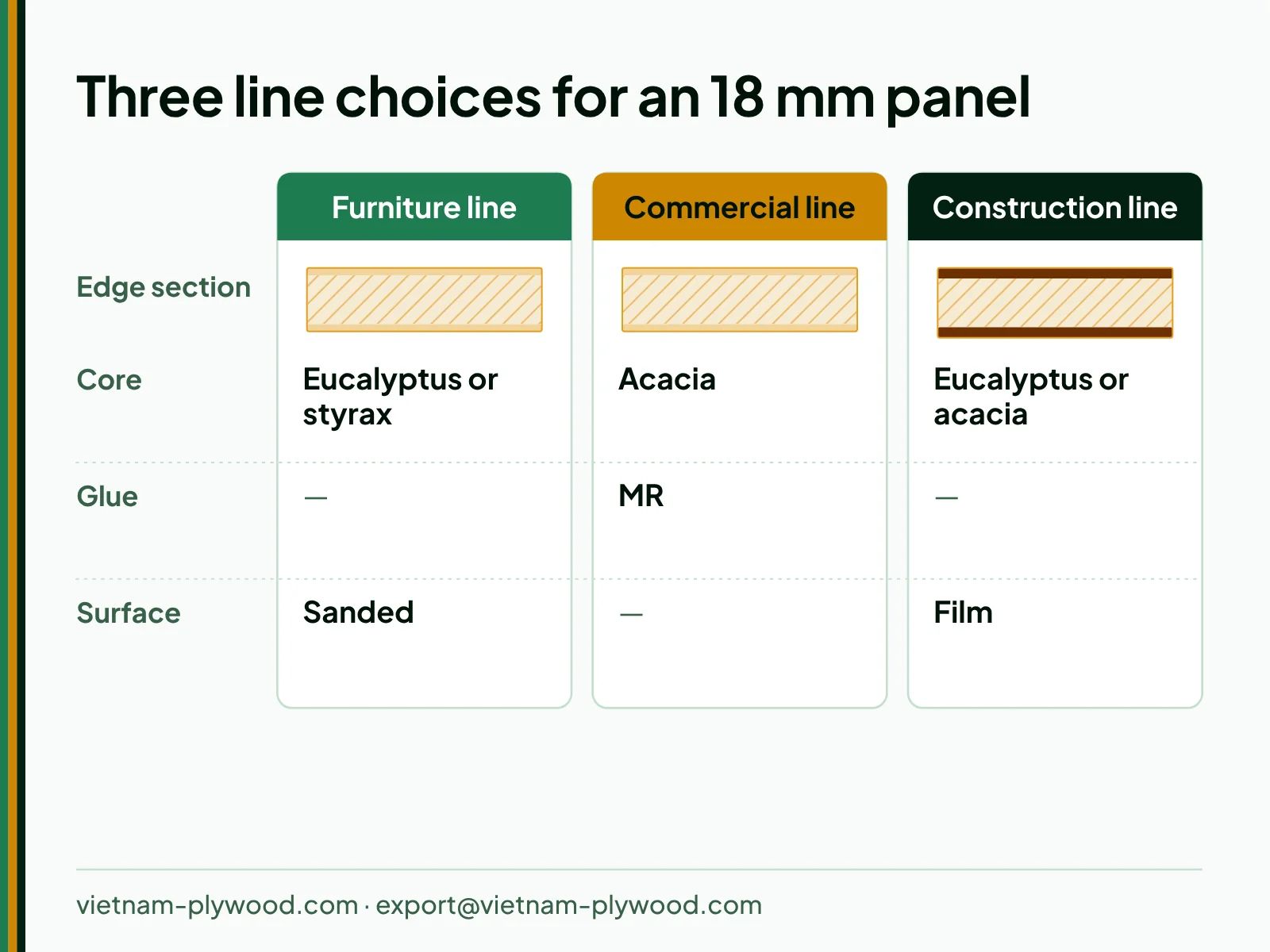
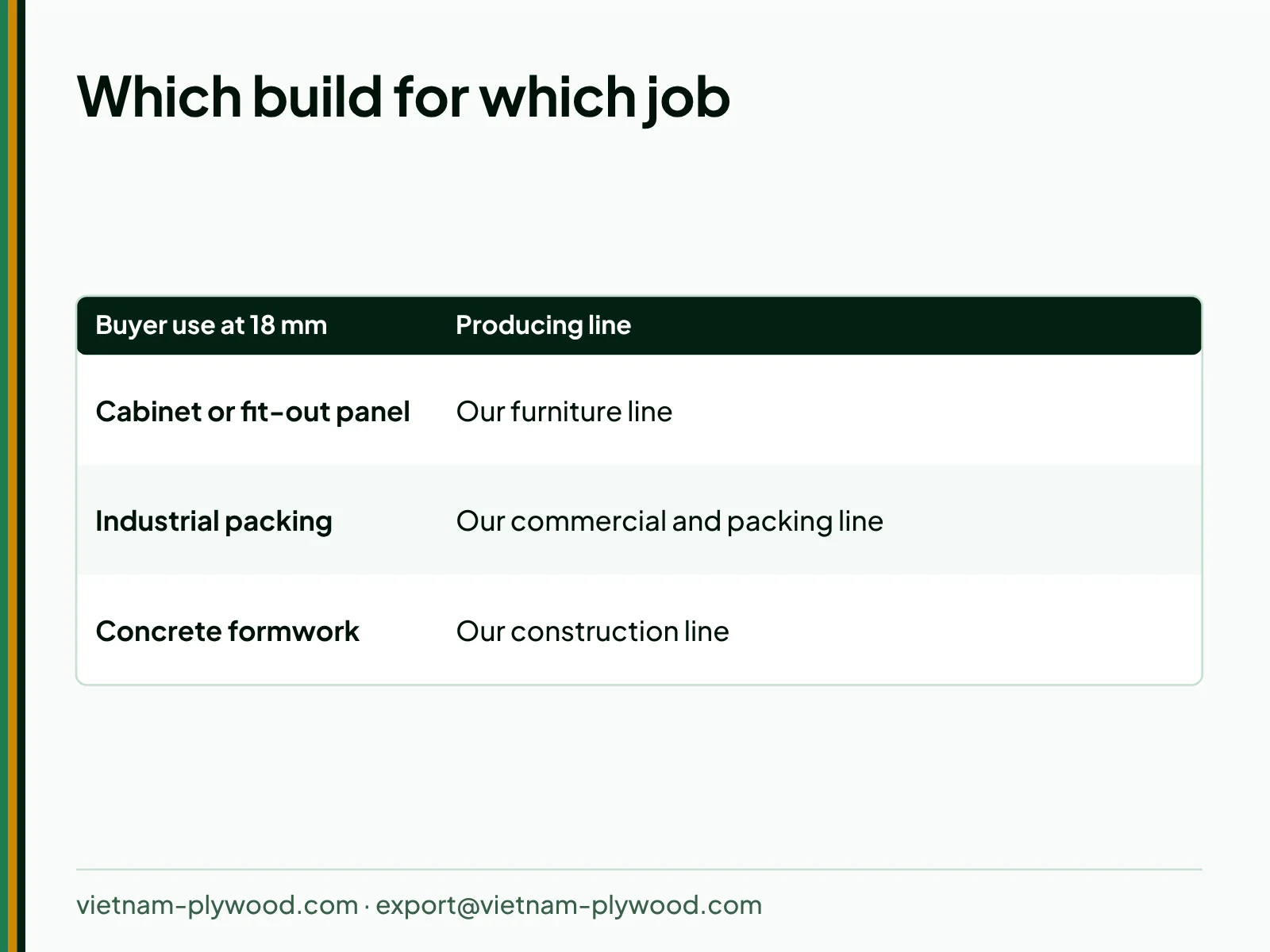
| Buyer use at 18 mm | Producing line | Core and surface | Glue and finish | Thickness tolerance |
|---|---|---|---|---|
| Cabinet or fit-out panel | Our furniture line | Eucalyptus or styrax; full stitched, sanded; selected veneer face | E0/E1 emission class specified separately | ±0.2 or ±0.3 mm as ordered |
| Industrial packing | Our commercial and packing line | Acacia; unsanded or light-sanded | MR glue | ±0.5–1.0 mm for packing |
| Concrete formwork | Our construction line | Eucalyptus or acacia; film surface, unsanded core | Melamine or phenolic system to order | ±0.5 mm |
See eucalyptus plywood in Vietnam for the product context and commercial and packing plywood for the separate packing application.
Is eucalyptus wood strong enough for construction plywood?
Eucalyptus can be a core for construction film-faced plywood, but the species name alone cannot establish a structural rating or permissible load. Our construction line presses film-faced panels with eucalyptus or acacia cores. The buyer must specify the formwork duty, panel thickness, bonding system and the test report accepted for the project.
Phenolic glue is the weather-and-boil-proof (WBP) option, with a 72-hour boil specification; melamine glue is the moisture-resistant (MR) option, with a 12-hour boil specification. These are glue-system descriptions, separate from emissions classifications. Film choices are 120 g/m² standard, 135 g/m² premium or 220 g/m² anti-slip. A higher film weight does not itself establish bending capacity. Structural-grade language belongs only against a test report the buyer accepts.
Review plywood manufacturing options when setting the panel build.
How does eucalyptus peel and dry for plywood veneer?
Eucalyptus veneer production requires controlled peeling, sorting and drying before lay-up. Logs with suitable form are conditioned for peeling, veneer is cut and graded, and drying reduces moisture before adhesive application. The operating settings should match the actual wood and veneer condition rather than a generic species label.
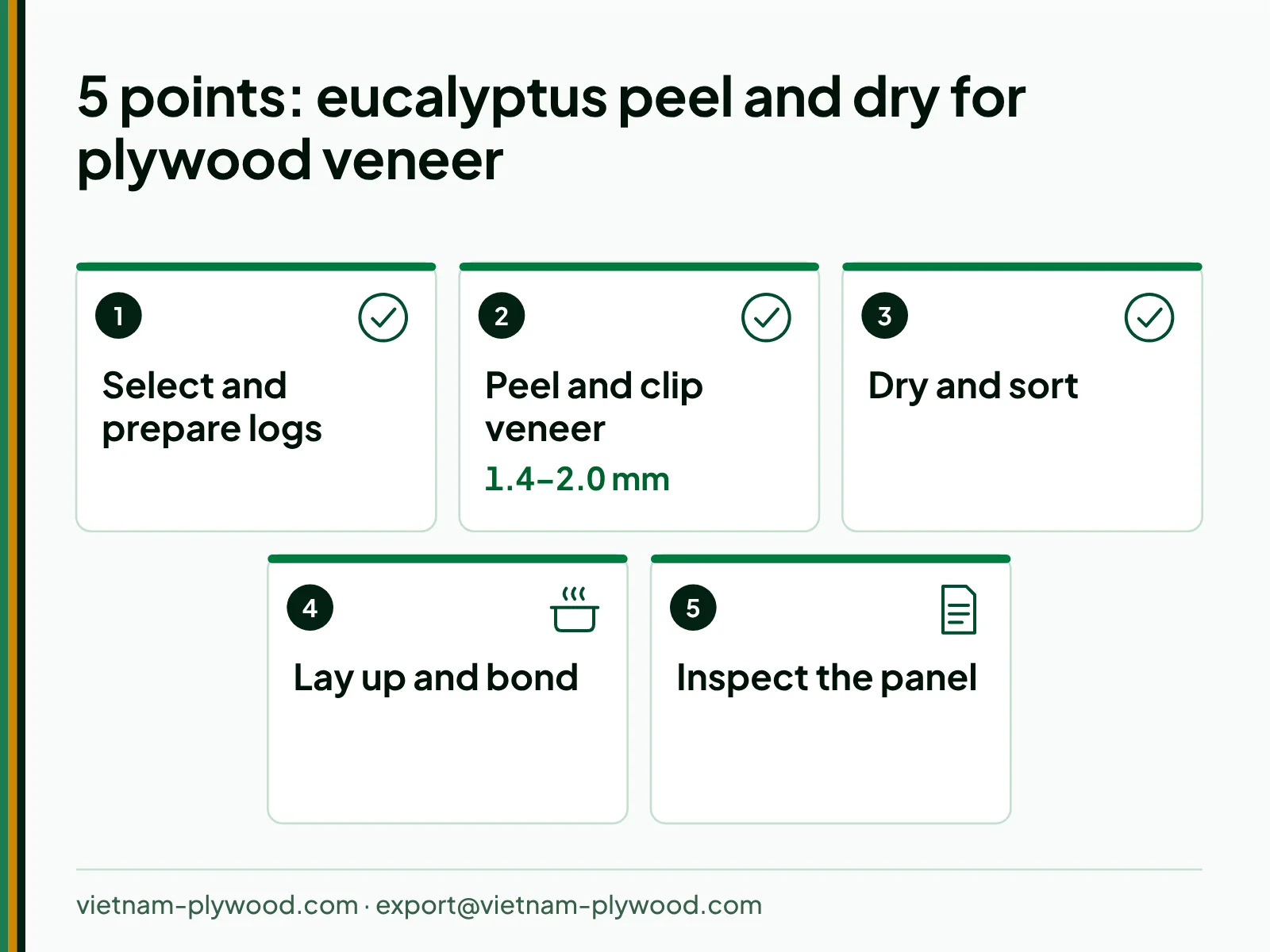
- Select and prepare logs. Check diameter, straightness and visible defects before rotary peeling.
- Peel and clip veneer. Separate sheets with splits, holes or irregular edges; the core veneer thickness range used in our builds is 1.4–2.0 mm.
- Dry and sort. Monitor moisture distribution, checks and curl; keep defective sheets out of higher-grade core assemblies.
- Lay up and bond. Specify full stitched or another agreed core construction, then press the selected adhesive system.
- Inspect the panel. Check thickness, edges, face condition and evidence of gaps or delamination.
Drying deserves attention: the US Forest Service’s 1964 study of Eucalyptus robusta lumber reported grade losses associated with splits, warp and surface checking (US Forest Service, 1964). That lumber study is a warning about defect mechanisms, not a veneer-drying schedule for Vietnamese plywood.
What are the disadvantages of eucalyptus wood?
The principal buying disadvantages are greater weight in a eucalyptus-core panel, the need to control veneer drying defects, and the risk of assuming that all eucalyptus species perform alike. Denser core material increases sheet mass and can reduce the number of panels carried within a payload limit. Poor veneer selection can leave splits, openings or uneven lay-up that finishing cannot conceal.
How fast do plantation eucalyptus trees grow in Vietnam?
Eucalyptus is a fast-growing plantation genus, but a single national rotation age is not established for every Vietnamese species, site and end product. A rotation chosen for pulpwood cannot be treated as the age required for large veneer logs. The buyer should distinguish plantation growth claims from the diameter and quality of the logs actually peeled.
World Agroforestry’s species database describes 6–10 years as a common Eucalyptus grandis rotation for pulpwood, fuelwood and mining timber in various countries; it recommends a substantially longer rotation for sawlogs (World Agroforestry species management database). Those figures are international species context, not a measured Vietnam-wide harvest cycle. For veneer procurement, usable log diameter, defects and recovery matter more than quoting a plantation age without site data.
What changes in a 40HC shipment?
A eucalyptus-core load is heavier per sheet, so the packing plan must be built from the actual core mix. For 18 mm sheets at 1220 × 2440 mm, the eucalyptus plan is 53 sheets per pallet × 15 pallets = 795 sheets, 42.60 m³ and 27.69 t. The acacia plan is 55 × 16 = 880 sheets, 47.15 m³ and 27.35 t; styrax is 55 × 18 = 990 sheets, 53.05 m³ and 26.52 t. These figures exclude film weight.
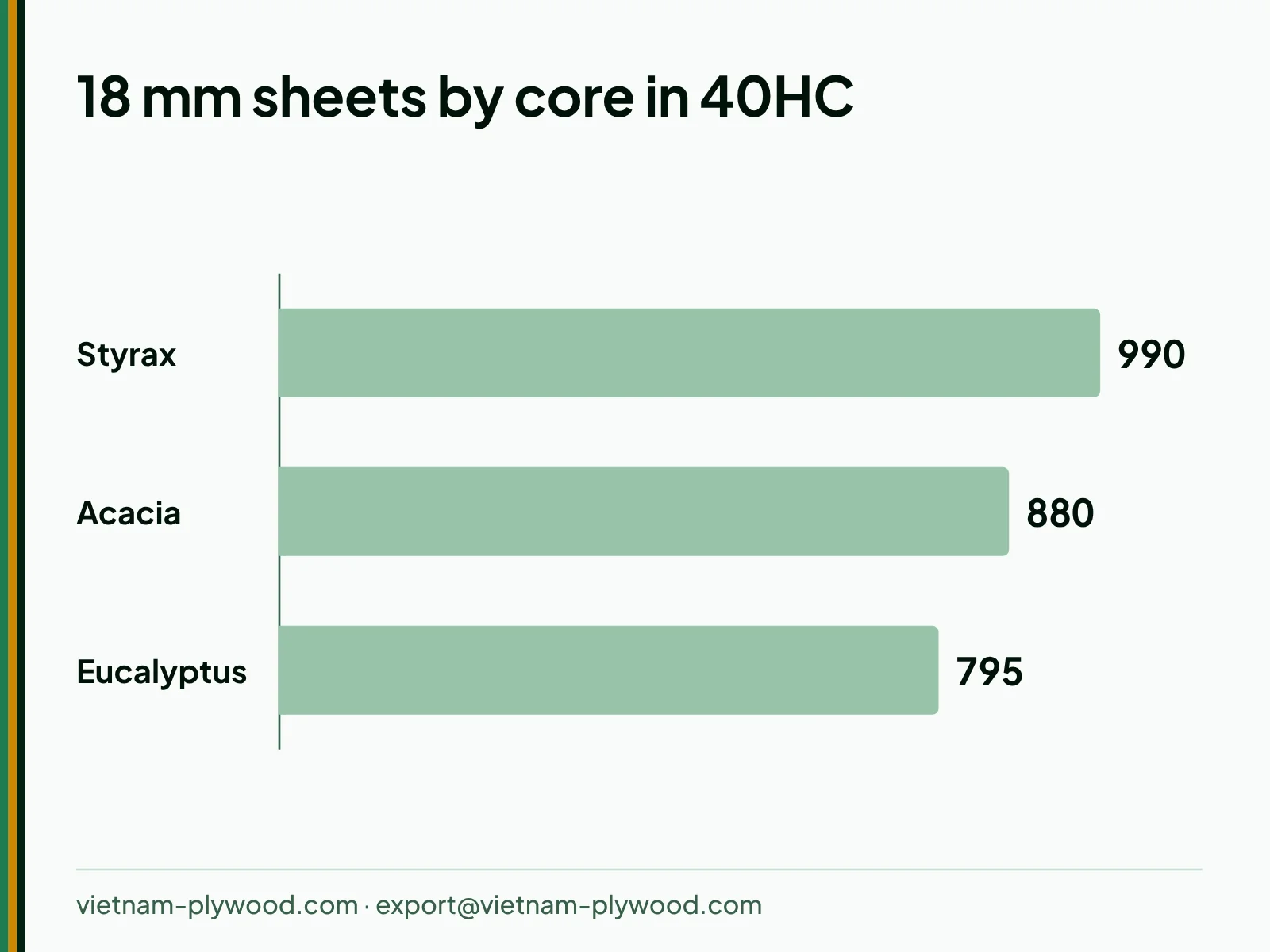
The 40HC payload limit is 28.5 t. Different specifications can share a container within that limit: for example, the buyer can allocate some pallet positions to heavier eucalyptus-core panels and others to lighter styrax-core furniture panels, then recalculate total loaded mass from the agreed quantities. A mixed shipment cannot use the full-load sheet count for each core simultaneously. The container-loading reference owns the detailed loading question, while several plywood types in one order explains the purchasing arrangement.
What can an inspector check at the producing factory?
An inspector can witness the core construction and dimensions that the order actually specifies. At the producing factory, start with a marked production lot and compare the approved specification with the material staged for lay-up. Check whether the eucalyptus core is used where ordered, whether face and core labels are distinct, and whether visible joints match the specified construction.
Inspect panel edges for openings, record measured thickness across the sheet, and examine face quality after pressing or sanding. For a furniture order, check the ordered ±0.2 or ±0.3 mm thickness tolerance; for a film-faced order, check ±0.5 mm. Length and width tolerance is ±2 mm. HCPLY manages specification, on-site quality control, export documents and loading. Buyers can visit the factory office and inspect the goods at the producing factory. The packing list identifies shipped quantities; any agreed emission certificate or test report belongs with the order’s certificate documents.
How should buyers specify and order eucalyptus plywood?
Specify the application first, then the core and face separately. A furniture buyer may choose a eucalyptus core for the weight and build requirements while selecting another decorative face. A formwork buyer should name the film, glue system and required test evidence. A packing buyer should specify the acacia-core commercial build instead of asking for a eucalyptus core that our packing line does not make.
For commercial plywood, the indicative starting price is from US$250/m³ FOB Hai Phong (October 2026); for furniture plywood, it is from US$350/m³ FOB Hai Phong (October 2026). Core construction, face grade, sanding, thickness and adhesive drive the quotation. Full stitched and sanded furniture construction costs more to make than a basic unsanded packing build because of veneer selection and finishing. Construction film-faced prices require a written build specification.
The minimum order is one 40HC, with mixed specifications within the payload limit. Factory lead time runs 15–45 days from receipt of the 30% deposit; the exact figure depends on order size, line loading and what the contract fixes. The remaining 70% is paid on the scan of the bill of lading, by T/T, or by irrevocable sight L/C. We ship FOB Hai Phong, or CFR (CNF) or CIF to your port. Lucy can review a specification through contact or export@vietnam-plywood.com.
What should go on the factory-visit brief?
A useful factory-visit brief states the intended panel and the measurable checks. For eucalyptus-core furniture panels, ask to see core stitching, sanding and thickness measurement. For film-faced panels, ask to see the selected core and film finish, plus the agreed bond-test documentation. The face name on a sales sheet must match the ordered face rather than silently substituting for the core description.
HCPLY operates our three factories in Phu Tho and Hai Phong, with each order produced on the line that fits its specification and shipped directly from that factory. The member factories’ FSC, CARB P2, ISO 9001 and CE certificates, and EUDR/EUTR documents, are shown with factory details masked, on request. Ask for the documents relevant to the ordered build and destination, including the EU file set where applicable.
Send a compact specification before arranging the visit:
Application: furniture / cabinet / packing / formwork
Producing line or core: furniture eucalyptus / construction eucalyptus / packing acacia
Glue: melamine MR / phenolic WBP as applicable
Emission class: E0 / E1 / E2 or agreed market requirement
Face and grade: species, A/B (birch D/E/F); or film type
Thickness and tolerance: ___ mm; ___ mm
Size: ___ × ___ mm
Quantity: ___ sheets / ___ m³
Destination port: ___
Next step: Book a factory visit with Lucy and bring the agreed panel specification.