





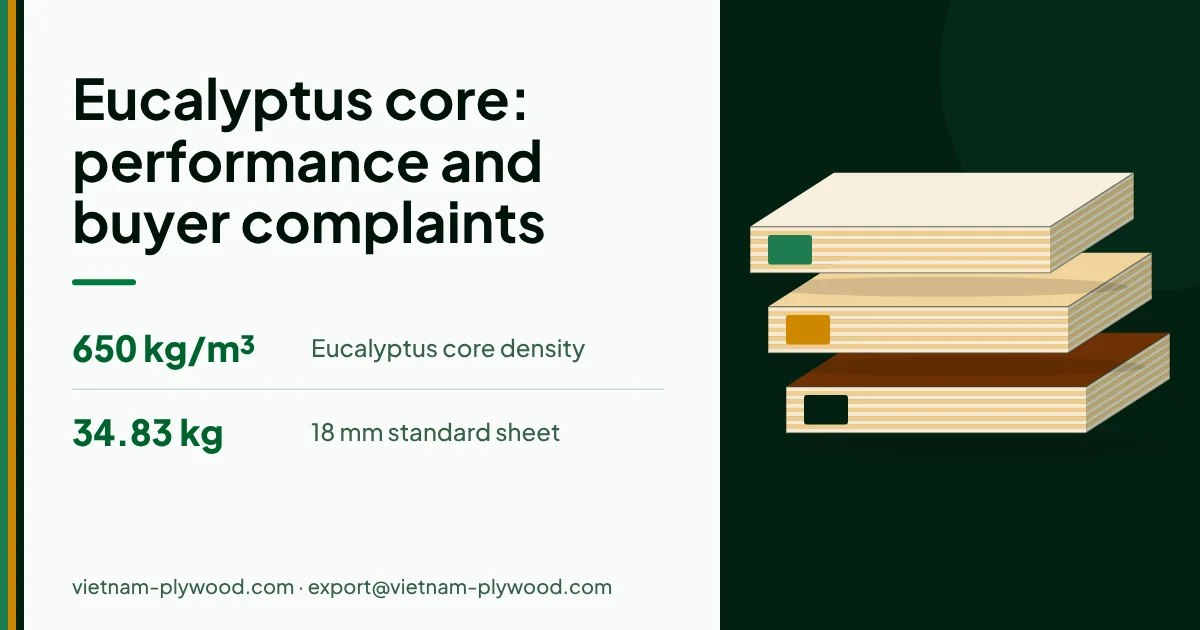
Eucalyptus plywood earns its place in dense furniture cores and film-faced panels, but weight, face variation and core gaps cause buyer complaints. A wrong core or surface specification can mean expensive handling, rejected cabinet faces or delayed assembly. This eucalyptus plywood review explains the choices HCPLY buyers should settle before ordering.
What is eucalyptus plywood?
Eucalyptus plywood is a layered veneer panel in which eucalyptus can form the core, the face, or both. These constructions are different products even when sellers use the same short name. HCPLY uses eucalyptus core on our furniture line and our construction line; our commercial and packing line uses acacia core. The core controls the density figure, while the face controls the visible species name.
For a detailed product specification, see eucalyptus plywood from Vietnam. A eucalyptus face over another core gives the appearance of eucalyptus without the same panel weight. An eucalyptus-core panel with a decorative face gives the opposite combination. Buyers should write both fields on the purchase specification.
Is eucalyptus plywood good quality?
Eucalyptus plywood can be a good furniture or industrial panel when the core layup, adhesive, face grade and thickness are matched to the job. At 650 kg/m³ for our eucalyptus core, its density gives a useful starting point for evaluating weight and fastening applications. Density alone does not establish bending strength, screw withdrawal resistance or a structural rating; those require a test method and an agreed acceptance value.
Our furniture line uses full-stitched, sanded eucalyptus or styrax core. Full stitching closes the gaps between core veneers before pressing, making it the sensible starting build for visible furniture components and machined edges. For load-bearing floors or structural designs, buyers need application-specific engineering and test evidence rather than a species label.
What is the difference between eucalyptus-faced and full eucalyptus plywood?
Eucalyptus-faced plywood identifies the outer veneer; full eucalyptus plywood describes eucalyptus veneer throughout the panel. A eucalyptus face can cover another core, so a face description cannot establish density or internal construction. Conversely, a birch, okoume or bintangor face can sit over eucalyptus core and retain the eucalyptus-core weight.
Our common face veneer thickness is 0.2–0.4 mm. For decorative work, specify face species and A/B face grade separately from core species and stitching. Birch faces use D/E/F grades in our range. When a supplier says “full eucalyptus,” request a photographed edge or a witnessed cut section to establish the actual layup.
Which build fits furniture, packing or formwork?
The furniture line presses the sanded eucalyptus-core option; the construction line presses film-faced eucalyptus-core panels. Our commercial and packing line builds acacia-core MR panels instead. The same nominal 18 mm thickness therefore describes three different buying decisions.
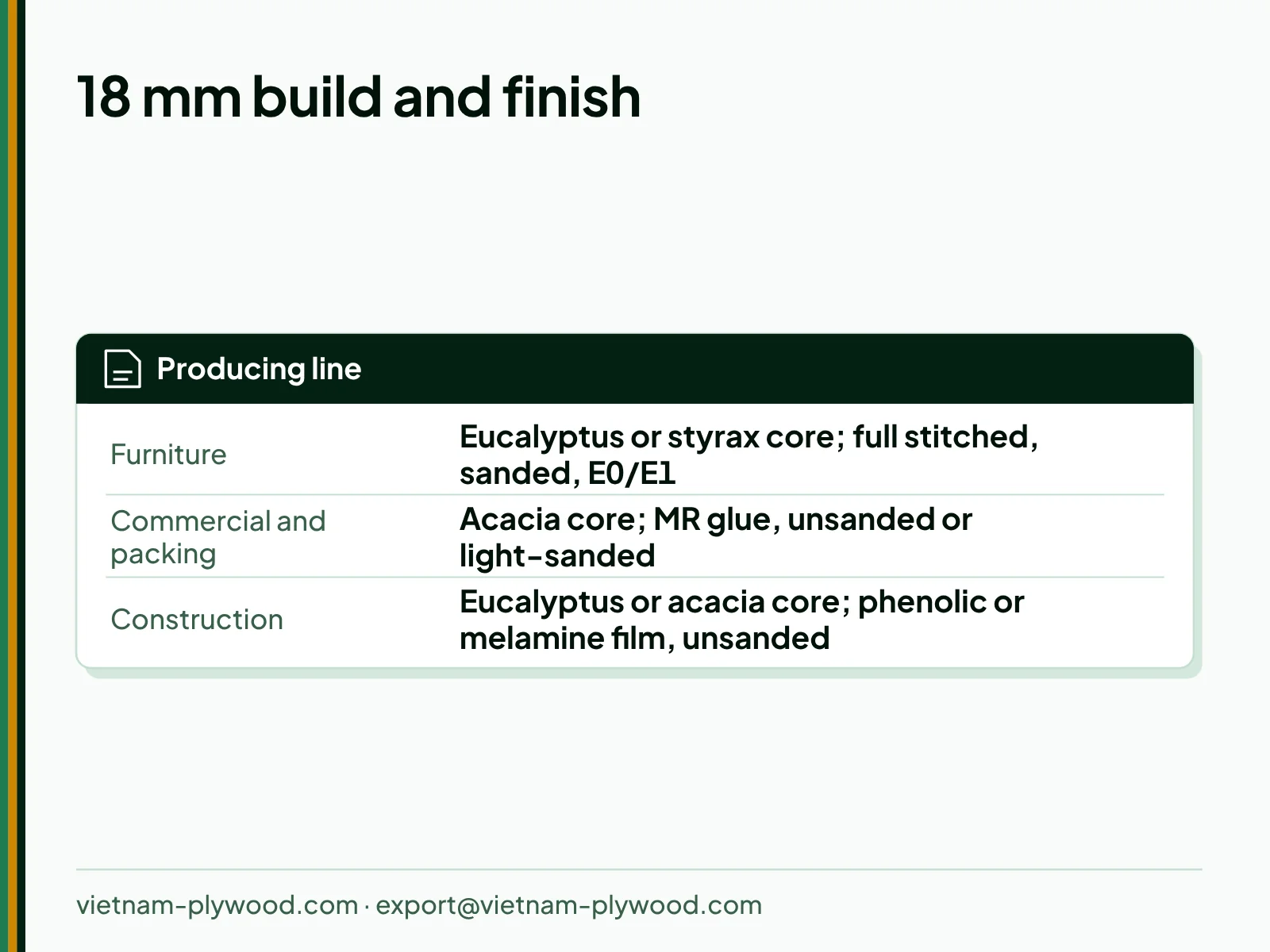
| Producing line | 18 mm build and finish | Core density | Thickness tolerance | Verdict by use |
|---|---|---|---|---|
| Furniture | Eucalyptus or styrax core; full stitched, sanded, E0/E1 | 650 or 500 kg/m³ | ±0.2 or ±0.3 mm as ordered | Cabinet components and visible furniture |
| Commercial and packing | Acacia core; MR glue, unsanded or light-sanded | 580 kg/m³ | ±0.5 mm commercial; ±0.5–1.0 mm packing | Packing and non-decorative industrial work |
| Construction | Eucalyptus or acacia core; phenolic or melamine film, unsanded | 650 or 580 kg/m³ | ±0.5 mm | Concrete formwork and film-faced jobs |
Our construction line offers 120 g/m² standard film, 135 g/m² premium film or 220 g/m² anti-slip film. These are surface specifications, not proof of a structural grade. See how several plywood types are organized for the production distinction.
What is eucalyptus plywood used for?
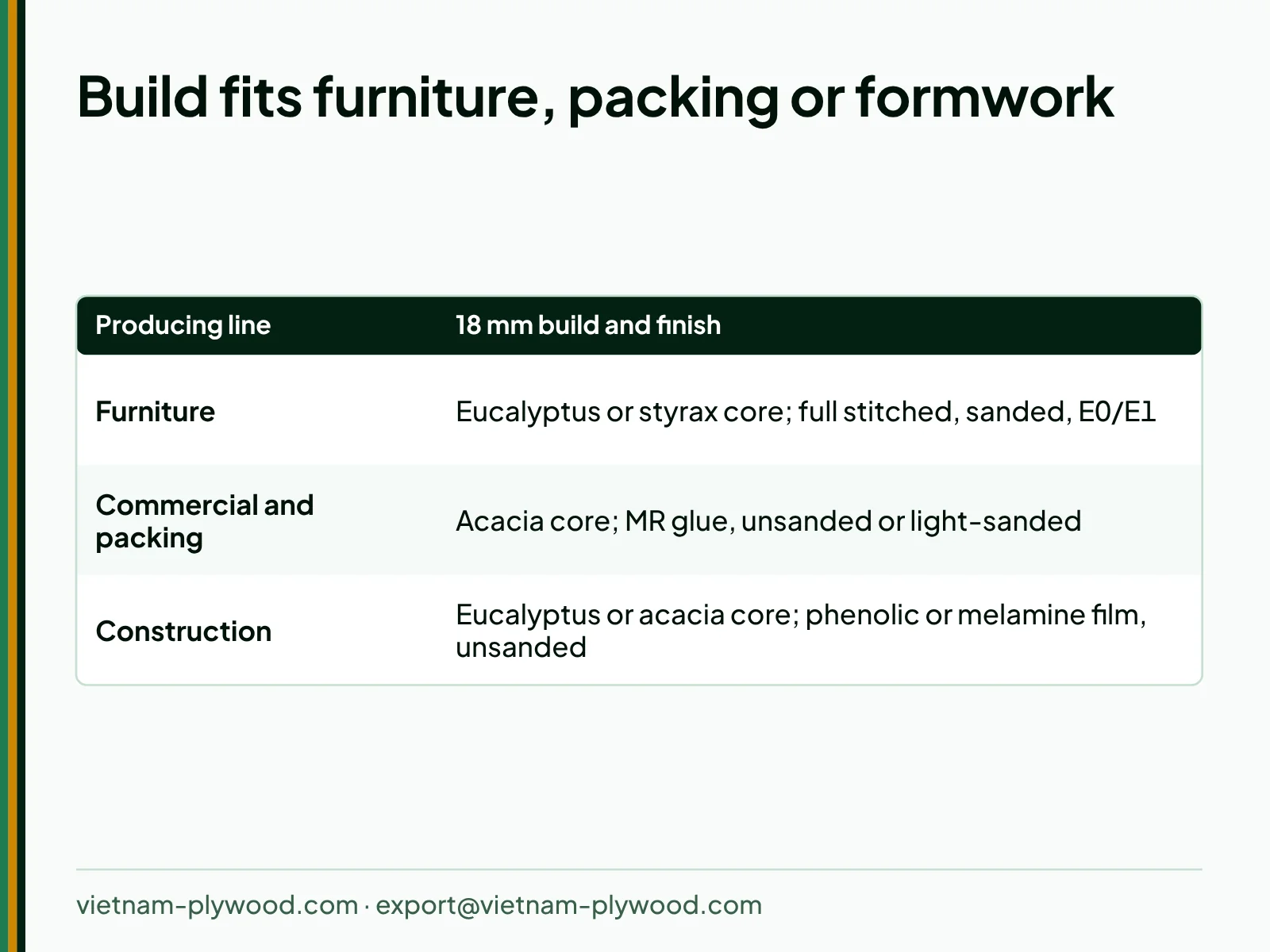
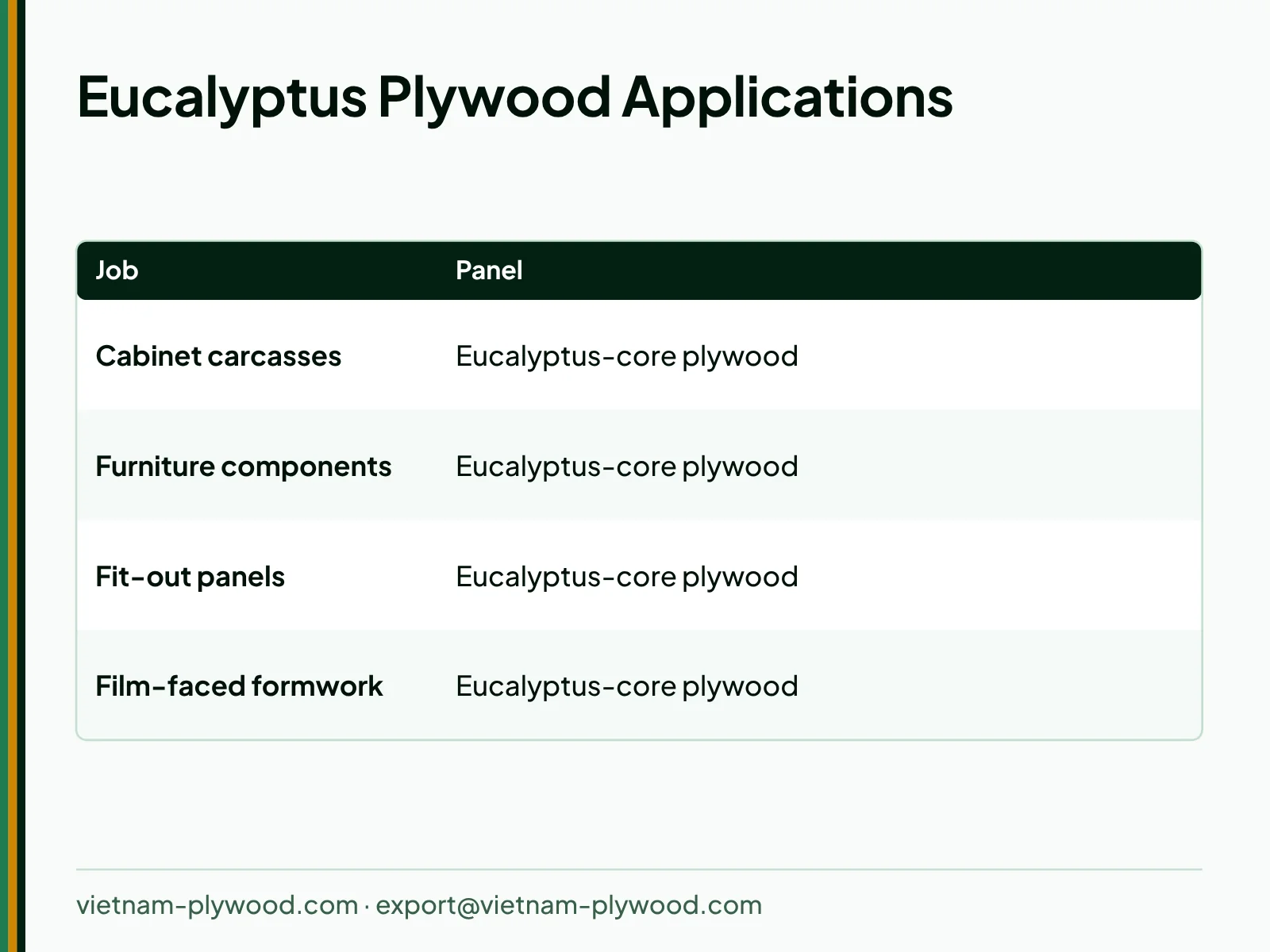
Eucalyptus-core plywood is a candidate for cabinet carcasses, furniture components, fit-out panels and film-faced formwork when the specified build matches the service conditions. For cabinet hardware, compare screw-holding on actual samples with the chosen screw, pilot hole and edge distance. For floors, check the span, support arrangement, concentrated loads and applicable engineering requirements before selecting a panel.
For formwork, choose the film and adhesive around the pour conditions and edge treatment. With proper handling, a release agent on every pour and sealed edges, including cut edges, melamine-glue film-faced panels achieve about 12–15 pours; phenolic-glue panels reach up to about 25 pours. These are handling-dependent figures, not a property of eucalyptus species alone.
Is eucalyptus plywood suitable for furniture?
Yes: eucalyptus-core plywood is suitable for furniture where the design can accommodate its weight and the buyer specifies a stitched, sanded core with the required face. At 18 mm and 1220×2440 mm, our eucalyptus-core sheet weighs 34.83 kg, compared with 26.79 kg for styrax core. That difference matters for tall cabinets, movable furniture and handling during assembly.
Choose a visible face for appearance, then approve a physical sample for colour and grain. A/B veneer grade and a smooth sanded face address different acceptance criteria: appearance and surface preparation. For concealed cabinet backs or components where weight dominates, a styrax-core furniture build can be the better specification.
How much does eucalyptus core change shipping weight?
An 18 mm, 1220×2440 mm eucalyptus-core sheet weighs 34.83 kg, and the corresponding full 40HC lookup is 795 sheets, 42.60 m³ and 27.69 tonnes. At the same thickness and format, styrax core gives 990 sheets and 26.52 tonnes; acacia core gives 880 sheets and 27.35 tonnes. The 40HC payload ceiling is 28.5 tonnes.
A mixed shipment can combine furniture and construction specifications within that limit, with pallets and quantities checked against the actual load plan. The eucalyptus figure excludes added film weight. For the complete container-count method, use the plywood packing calculator and mixed-container arrangements.
What complaints do buyers raise, and which specification prevents each?
The most useful complaints to examine are weight, uneven colour, face checking, voids, warped panels and rough machining edges. Each points to a different inspection or specification choice; treating them all as “poor eucalyptus” hides the cause.
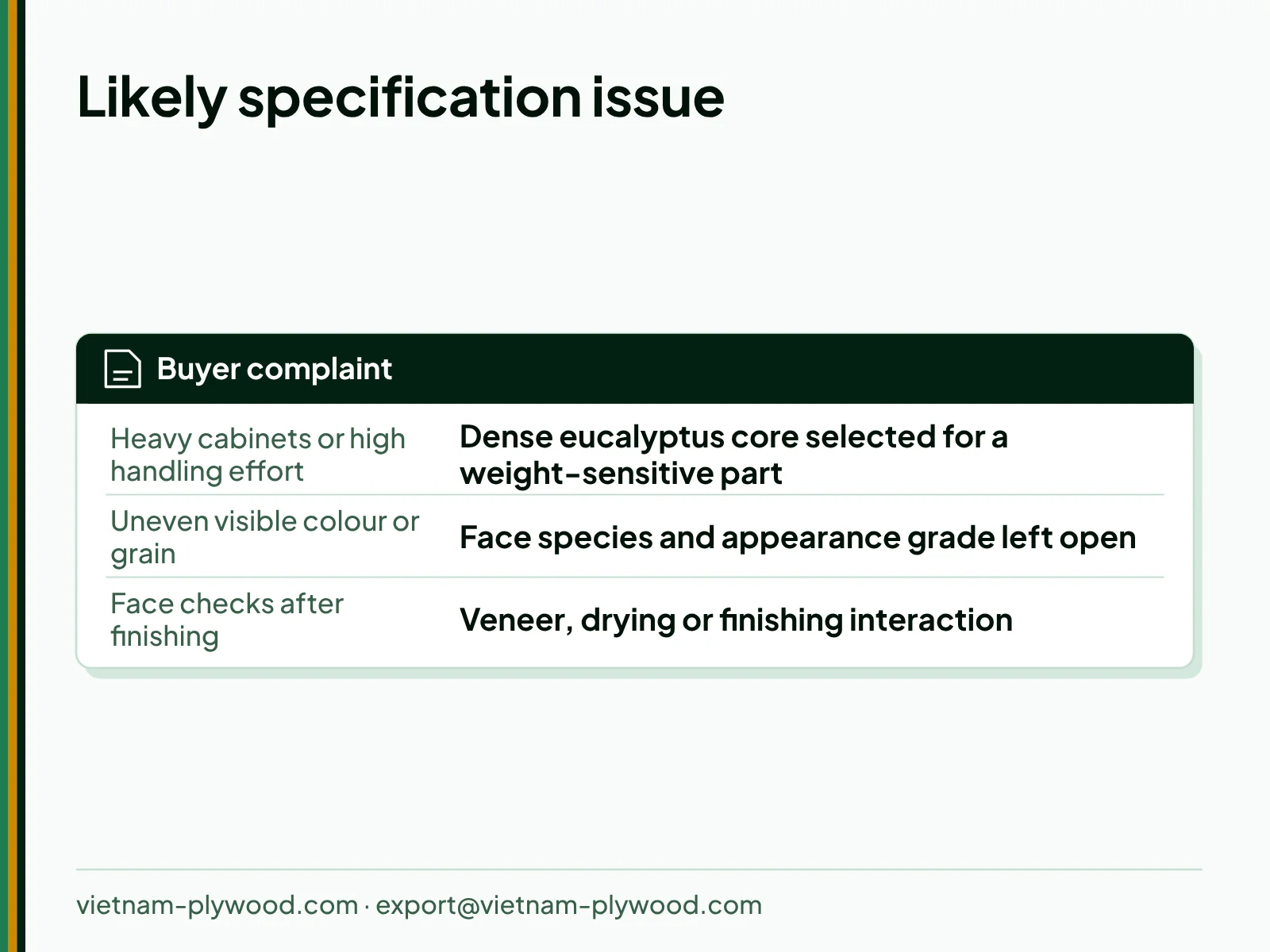
| Buyer complaint | Likely specification issue | Purchase-order action |
|---|---|---|
| Heavy cabinets or high handling effort | Dense eucalyptus core selected for a weight-sensitive part | Compare 650 kg/m³ eucalyptus with 500 kg/m³ styrax core |
| Uneven visible colour or grain | Face species and appearance grade left open | State face species, A/B grade and approved sample |
| Face checks after finishing | Veneer, drying or finishing interaction | Approve a finished sample and define allowable face defects |
| Open edge gaps or voids | Loose-laid or lower-grade core construction | Order full-stitched core and inspect cut edges |
| Panel bow or twist | Moisture balance, storage or layup problem | Agree a flatness acceptance method and inspect pallets |
| Chipping at CNC edges | Core gaps or unsuitable cutter setup | Trial-cut the ordered build before production release |
A buyer should distinguish a cosmetic complaint from a measured performance failure. Neither a species name nor a face photograph substitutes for an agreed inspection standard.
Which glue and emission class should the order state?
Specify adhesive and formaldehyde emission requirements as separate fields. Melamine moisture-resistant (MR) glue is associated with a 12-hour boil specification in our range; phenolic weather-and-boil-proof (WBP) glue with a 72-hour boil specification. These describe the adhesive system, not the panel’s emission classification.
For interior furniture, specify E0 or E1 as required by the order. For the US market, the US Environmental Protection Agency’s 2025 Code of Federal Regulations, 40 CFR §770.10, sets a 0.05 parts-per-million formaldehyde limit for regulated hardwood plywood with veneer or composite core and provides for third-party certification under TSCA Title VI. See the official 2025 regulation. Relevant member-factory certificates, including CARB P2 documentation, are shown with factory details masked, on request.
What should an inspector witness at the producing factory?
An inspector can check the cut edge, face, thickness and pallet markings against the signed specification. At the producing factory, start by identifying the core species and counting plies on representative cut sections. At 18 mm, the usual core veneer build has 11–13 plies, depending on individual veneer thickness of 1.4–2.0 mm.
Measure thickness at agreed locations: furniture sanded tolerance is ±0.2 or ±0.3 mm as ordered, while commercial and film-faced tolerance is ±0.5 mm. Length and width tolerance is ±2 mm. Inspect face checks under agreed lighting, and retain photos of the same reference samples used to approve production.
What should importers put on the order and document request?
The order should name the application, core, face, glue, emission requirement, size, tolerance and acceptance method. HCPLY handles specification, on-site quality control, shipping documents and loading, with each order produced and dispatched from its matching factory FOB Hai Phong. Buyers can visit the factory office and inspect at the producing factory.
The commercial invoice and packing list identify the shipped product and quantities; the bill of lading (B/L) records the carriage. The shipment document set also includes the certificate of origin, phytosanitary and fumigation papers, insurance under CIF, agreed test and certificate documents, and an EUTR/EUDR file set for EU lots. After loading, the draft shipping documents come to you for approval.
What changes the quotation for eucalyptus plywood?
The largest build decisions are core species and construction, then face selection and grade, adhesive and emission requirements, surface finish, and thickness or cutting. A full-stitched, sanded furniture build requires more preparation than a loose-laid unsanded construction; a premium visible face adds selection work. Film type and requested testing also change the construction specification.
The minimum order is one 40HC, with mixed specifications permitted within payload limits. Factory lead time runs 15–45 days from receipt of the 30% deposit; the exact figure depends on order size, line loading and what the contract fixes. The remaining 70% is paid on the scan of the bill of lading, by T/T, or by irrevocable sight L/C. We ship FOB Hai Phong, or CFR (CNF) or CIF to your port.
What specification should a buyer send next?
Send the intended application and acceptance conditions before requesting a sample set. HCPLY can prepare the appropriate furniture or construction sample against the written fields below; for packing applications, specify the acacia-core alternative. Free samples are available, with new buyers booking their own courier; the courier cost can be credited against a real order.
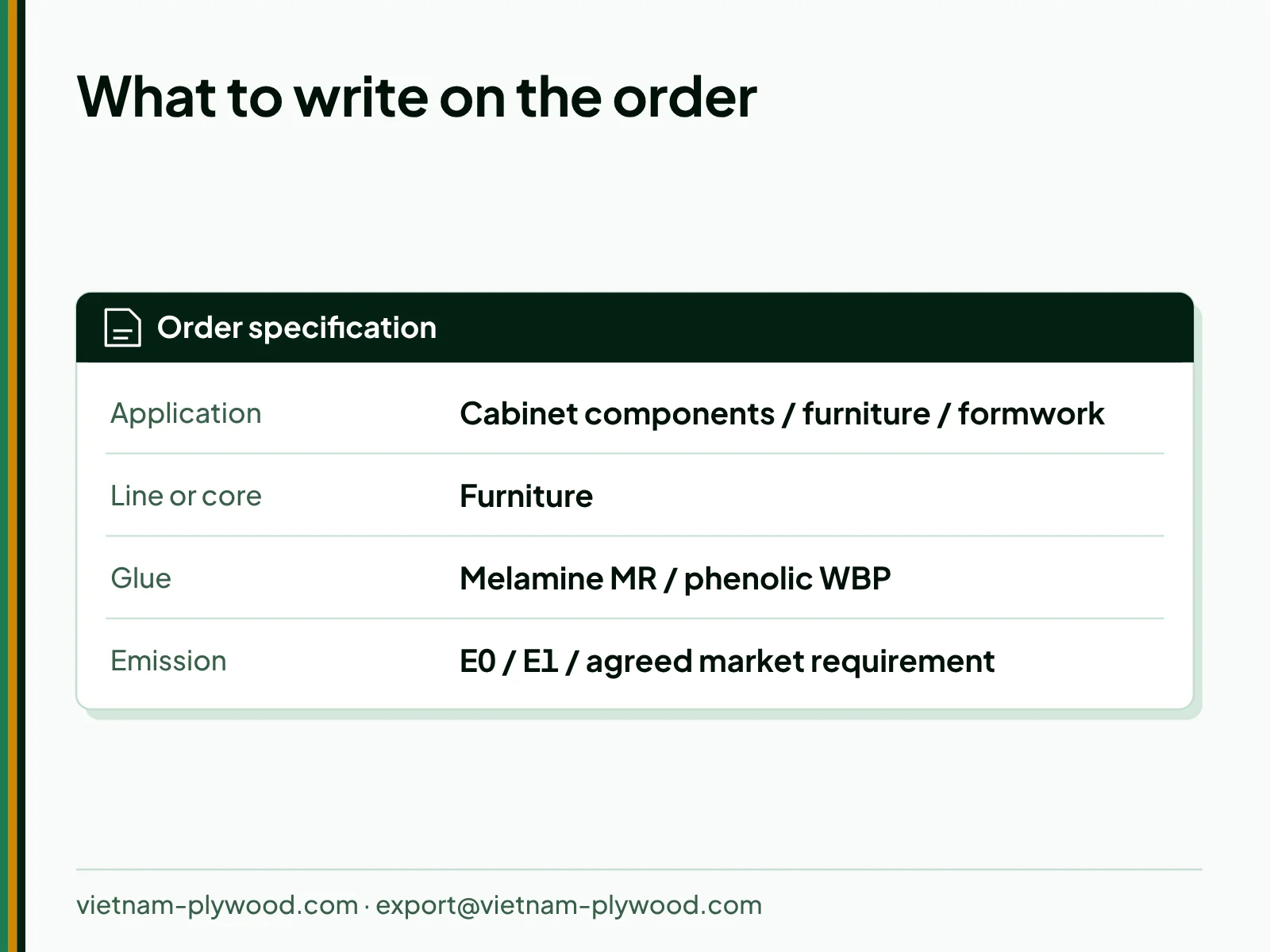
Application: cabinet components / furniture / formwork
Line or core: furniture — eucalyptus core / construction — eucalyptus core
Glue: melamine MR / phenolic WBP
Emission: E0 / E1 / agreed market requirement
Face and grade: eucalyptus / other approved face; A/B as applicable
Thickness and tolerance: 18 mm; furniture ±0.2 or ±0.3 mm / film ±0.5 mm
Size: 1220 × 2440 mm
Quantity: one 40HC or stated mixed-load allocation
Destination port: [port, country]
Ask Lucy at the contact page or export@vietnam-plywood.com for a sample set matched to this specification.