

When contractors compare formwork plywood costs, they often look at price per sheet. The smarter number is cost per pour. Eucalyptus core formwork plywood costs more per sheet — but at 15-20 reuse cycles versus 8-12 cycles for acacia core, the per-pour economics shift decisively. This article explains the mechanism behind that difference and how to specify the right panel for your project.
📋 The Core of Formwork Reuse Performance
Film-faced formwork plywood fails in two ways: the film delaminates from the substrate, or the substrate itself crushes under repeated load. Both failure modes are density-dependent. Higher core density directly delays both failure types.
Vietnamese plywood manufacturers produce formwork panels from two primary core species: eucalyptus (650-750 kg/m³) and acacia (~580 kg/m³). Styrax core (480-500 kg/m³) is not used for formwork — its lower density and softer fiber structure cannot sustain the mechanical abuse of concrete work.
The formwork reuse cycle gap is not theoretical. It shows up on construction sites where the same film specification and glue type produces different panel lifespans from different core species.
⚠️ Important: Reuse cycle counts depend on three variables together — core density, film weight (gsm), and glue type. Eucalyptus core with lightweight film or MR glue will not reach 15-20 cycles. The figures cited here assume AICA 135 gsm film and phenolic (WBP) glue — HCPLY’s standard premium formwork specification.
📊 Reuse Cycles by Core and Factory Grade
Vietnam produces formwork plywood across two factory segments (source: HCPLY factory operations, 2026):
| Segment | Core | Film | Glue | Reuse Cycles |
|---|---|---|---|---|
| Premium (Type C factory) | Eucalyptus 650-750 kg/m³ | AICA 135 gsm | Phenolic WBP | 15-20x |
| Mid-grade | Acacia ~580 kg/m³ | AICA or import 120-135 gsm | Phenolic or MR | 8-12x |
| Budget (Type D factory) | Acacia ~580 kg/m³ | VN/CN budget film | MR + 5-15% phenolic blend | 4-8x |
The 15-20x reuse range for eucalyptus core is achievable in typical construction conditions — standard concrete release agent, mechanical stripping, water cleaning between pours. Demanding conditions (chemical release agents, heat, tall pour heights with high vibration) push panels toward the lower end of the range.
For acacia core mid-grade panels, the 8-12x range assumes proper AICA film and WBP glue. Budget-grade acacia with lighter film or MR glue lands in the 4-8x range regardless of handling care.
🔧 Why Density Controls Reuse Life
📌 Substrate Resistance to Surface Crushing
Each formwork cycle involves three stress events: concrete pressure during pour, vibration during consolidation, and stripping force when the panel is pulled from cured concrete. All three compress the face veneer against the core.
Eucalyptus core at 650-750 kg/m³ resists this compression. Acacia core at ~580 kg/m³ compresses measurably more per cycle. That compression creates micro-fractures in the film-to-substrate adhesion layer. After enough cycles, those micro-fractures propagate to visible film lift.
📌 Film Bond Durability Under Thermal Cycling
Concrete curing generates heat. Formwork panels heat up during pour and cool between cycles. Thermal expansion and contraction creates stress at the film-substrate interface. Denser core expands and contracts less per thermal cycle — the tighter fiber structure of eucalyptus veneer has lower dimensional movement than the looser acacia fiber.
📌 Edge Integrity Under Water Exposure
Even with WBP glue, formwork panel edges accumulate water damage over multiple cycles. Dense eucalyptus core holds edge banding longer, preventing moisture ingress along the cross-section. Budget acacia cores — especially loose-laid construction — absorb water through exposed edges, causing internal delamination that accelerates failure.
Full stitched core construction (see plywood core construction guide) eliminates internal gaps that trap moisture. HCPLY’s premium formwork facility uses full stitched eucalyptus core in all panels targeting 15+ reuse cycles.
📐 Specifying High-Reuse Formwork Plywood — What to Confirm
Reuse cycle claims from Vietnamese suppliers require verification of four specifications. Do not accept a “15-20 reuse” claim without confirming all four:
⚙️ 1. Core Species
Ask specifically: Is the core eucalyptus or acacia? Many suppliers list “hardwood core” without specifying species. In Vietnam, hardwood core is typically acacia — which delivers lower reuse than eucalyptus core. The core species must be stated explicitly.
Eucalyptus core plywood is heavier per container (15 pallets per 40HC versus 16 for acacia), which is visible in the shipping weight calculation. If a supplier quotes high reuse cycles on a panel with a very low FOB price and high-volume container packing, the core is likely acacia, not eucalyptus.
⚙️ 2. Film Weight and Manufacturer
The standard for 15-20 cycle performance is AICA film at 135 gsm minimum. AICA (Japan) is the benchmark brand. Some suppliers substitute domestic Vietnamese film or Chinese-manufactured film of the same stated weight — the adhesion and film density often underperform AICA specifications.
120 gsm film — common in budget panels — achieves 10-15 cycles under ideal conditions, less under demanding site use. Ask for the film manufacturer’s data sheet.
3. Glue Type
Phenolic (WBP) glue is non-negotiable for high-reuse formwork. Melamine (MR) glue is moisture-resistant, not waterproof — it will degrade under repeated concrete contact and water cleaning. Some budget suppliers blend 5-15% phenolic resin into melamine glue and market the panel as “WBP” — this is not equivalent to full phenolic bonding.
Request the glue specification in writing and confirm it appears on the inspection certificate.
4. Core Construction Method
Full stitched core provides no internal gaps or overlaps. Loose-laid or edge-jointed acacia core creates internal voids that compress under load and absorb moisture — both accelerate reuse failure. Premium eucalyptus formwork panels use full stitched core construction.
💡 Cost-Per-Pour Analysis: Eucalyptus vs Acacia Core
“The eucalyptus panel costs 15% more per sheet. But if it lasts twice as many pours, the per-pour cost is 30% lower — and you have fewer panel replacement cycles, less site logistics, less waste.” — Lucy, HCPLY International Sales
Here is a simplified comparison framework (illustrative — actual figures vary by market and specification):
| Metric | Eucalyptus Core (Premium) | Acacia Core (Mid-Grade) |
|---|---|---|
| Reuse cycles | 15-20 | 8-12 |
| Relative price per sheet | ~115 | 100 |
| Cost per cycle (15 cycles vs 10 cycles) | ~7.7 | 10.0 |
| Panels needed for 100 pours | ~6-7 | ~9-12 |
| Site logistics (replacements, delivery) | Lower | Higher |
| Waste volume | Lower | Higher |
⚠️ Note: These are directional figures. Actual reuse depends on project conditions, handling practice, and release agent used. Request samples and trial on your project before committing to bulk order.
For projects with 20+ pours per form element, or where panel replacement is logistically difficult (high-rise, remote site), eucalyptus core is the lower total-cost choice despite the higher unit price.
For projects with 8-10 pours per cycle and low panel replacement cost, mid-grade acacia core is a rational choice — overpaying for eucalyptus density does not recoup the premium.
🏗️ Where Eucalyptus Core Formwork Plywood Is Specified
High-Rise and Civil Construction
Tall concrete pours generate higher lateral pressure on formwork panels. The structural integrity of the panel under high concrete pressure is directly tied to core stiffness. Eucalyptus core’s 650-750 kg/m³ density provides the stiffness margin required for wall forms, column forms, and slab decks under typical high-rise pour specifications.
EU, Japan, Korea Market Projects
European, Japanese, and Korean contractors and product standards for formwork plywood tend to specify film-faced panels with documented reuse cycle performance. HCPLY’s eucalyptus core formwork panels meet the EU CE standard and are certified for export to these markets with FSC and EUDR documentation.
HCPLY exports eucalyptus core formwork panels to construction projects in Germany, the Netherlands, South Korea, and Australia — markets where total lifecycle cost is a standard evaluation criterion.
Rental Formwork Operations
Companies that rent formwork systems rather than single-use panels require panels that complete the maximum possible cycles before replacement. For rental operators, eucalyptus core panels at 15-20 cycles dramatically outperform acacia core panels on total revenue per panel purchased.
📦 Container Loading: Weight Constraint for Eucalyptus Core
Eucalyptus core’s density advantage in formwork performance creates a logistics constraint. A 40HC container of eucalyptus core formwork plywood (1220×2440mm, 18mm thickness) loads 15 pallets at approximately 42.60 CBM and 27.69 MT cargo weight — near the 28.5 MT payload limit.
Compare to acacia core at the same specification: 16 pallets, ~47.15 CBM, ~27.35 MT. Styrax core: 18 pallets, ~53.05 CBM, ~26.52 MT.
Practical implication: If you are mixing eucalyptus and acacia core panels in one container, the HCPLY logistics team calculates total weight before finalizing the load. Eucalyptus panels approach the payload ceiling faster.
See the plywood container packing calculation guide for the full methodology.
⚙️ HCPLY Premium Formwork Panel Specification
HCPLY’s premium formwork panels targeting 15-20 reuse cycles are manufactured at a dedicated Type C facility in Northern Vietnam (Phú Thọ):
| Parameter | Value |
|---|---|
| Core species | Eucalyptus plantation, Northern Vietnam |
| Core density | 650-750 kg/m³ |
| Core construction | Full stitched (khâu full) |
| Film | AICA (Japan), 135 gsm minimum |
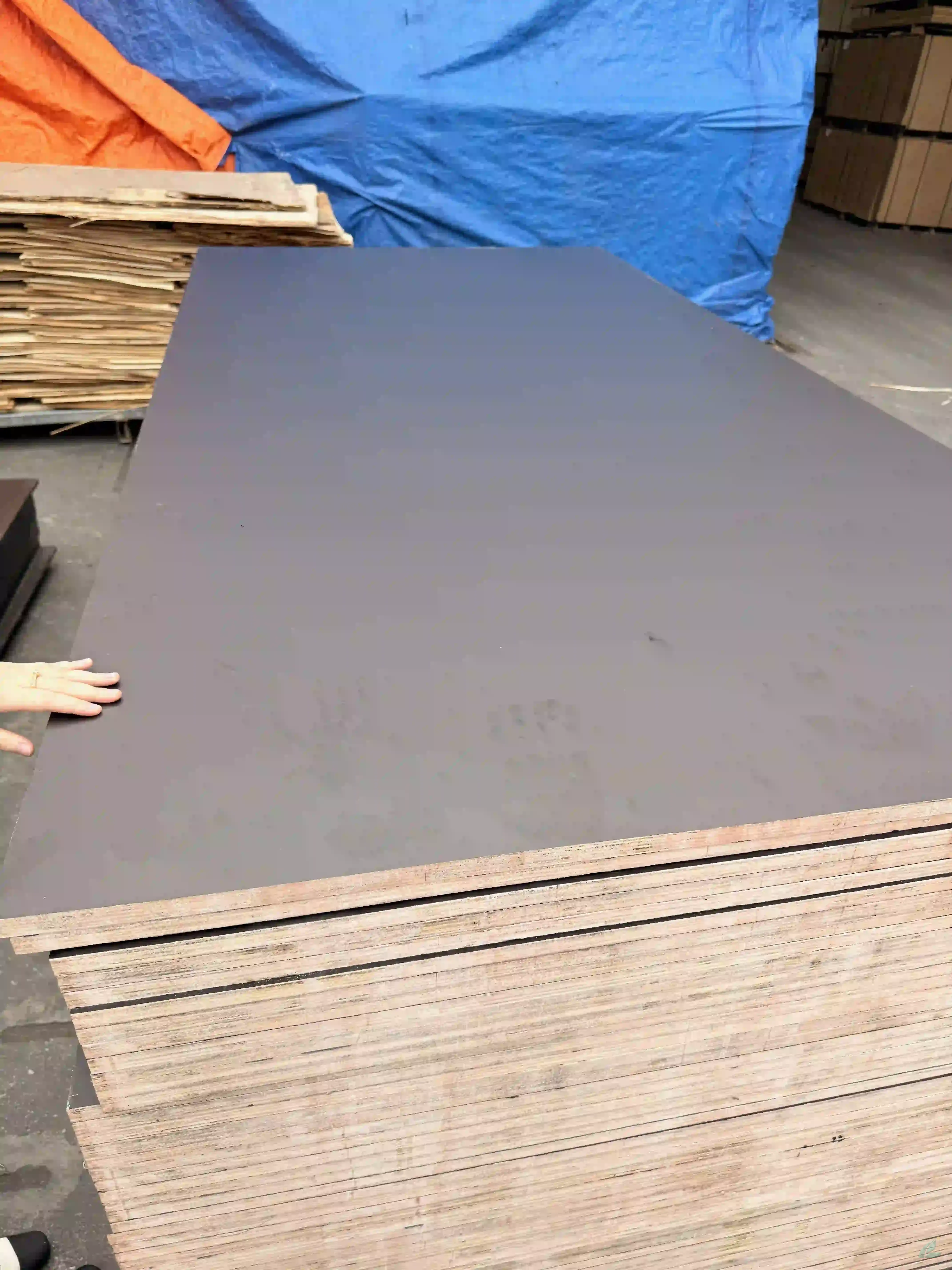
| Film color | Black (bottom face), Brown (top face) |
| Glue | Phenolic (WBP) |
| Standard thickness | 12mm, 15mm, 18mm, 21mm (most common) |
| Available thickness | 9-30mm |
| Standard size | 1220×2440mm; 1250×2500mm |
| Thickness tolerance | ±0.5mm |
| Reuse cycles | 15-20 (standard construction conditions) |
| Certifications | FSC, CARB P2, CE, ISO 9001, EUDR |
| MOQ | 1 × 40HC container |
| Lead time | 15-20 days |
| Port | FOB Hai Phong, Vietnam |
🔗 Related Articles in the Eucalyptus Core Series
This article is part of the P2 Core Types pillar. Related reading:
- Eucalyptus core plywood: heaviest, strongest for flooring and construction — full performance profile of eucalyptus core
- Plywood core types: acacia vs eucalyptus vs styrax — comparison across all three Vietnamese cores
- Acacia core plywood: best-value core for film-faced and packing applications — the alternative core for budget formwork
- Plywood core construction: stitched vs loose-laid — why construction method affects reuse
- Film-faced plywood Vietnam — full product page for film-faced panels
✅ Conclusion
Eucalyptus core formwork plywood’s 15-20 reuse cycle performance versus 8-12x for acacia core mid-grade is the direct output of a density advantage — 650-750 kg/m³ versus ~580 kg/m³. That density keeps the film bond intact longer, resists substrate crushing under concrete pressure, and holds edge integrity through repeated water cleaning cycles.
The per-sheet premium for eucalyptus core formwork is recouped in cost-per-pour calculations for projects with 15+ pours per form element. For fewer cycles or price-sensitive markets, acacia core mid-grade is a rational choice.
Three variables must align to reach 15-20 cycles: eucalyptus core substrate, AICA 135 gsm film, and phenolic WBP glue. Changing any one of the three reduces the reuse ceiling.
HCPLY manufactures premium eucalyptus core formwork panels from a dedicated production facility in Phú Thọ, Northern Vietnam — FSC, CARB P2, CE, and EUDR certified, with direct export capability and no VAT markup.
Request free eucalyptus core formwork samples and FOB quotation — include your standard thickness, sheet size, and target reuse cycle requirement.