





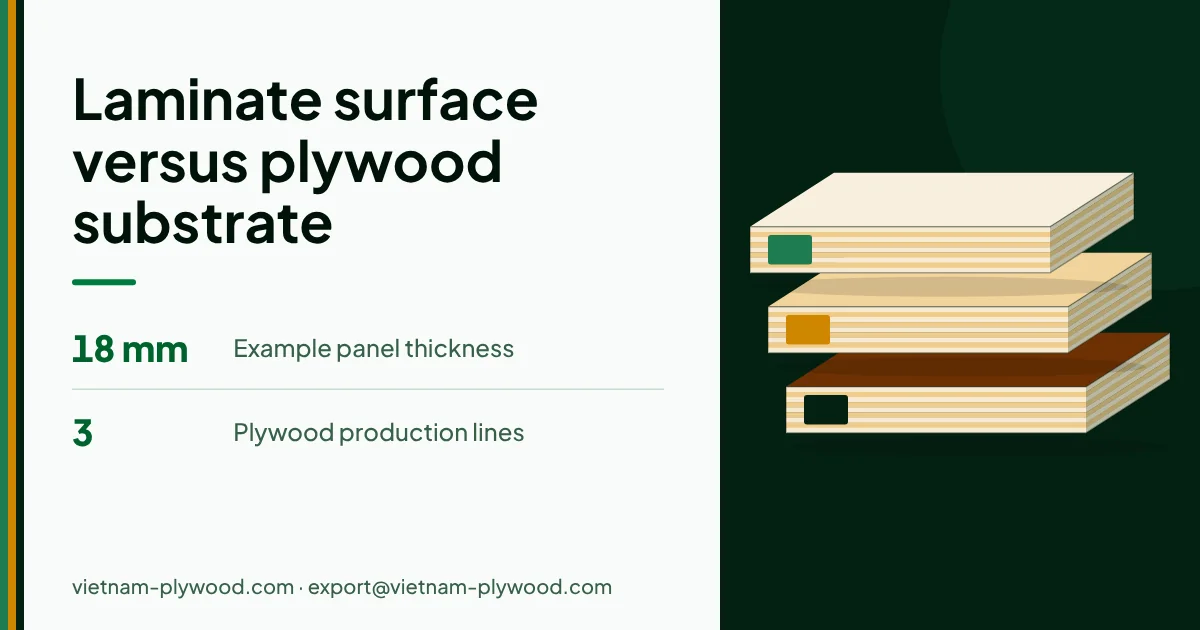
Decorative laminate sheets give furniture and cabinet panels a selected surface finish, while plywood supplies the substrate or an alternative visible veneer face. Choosing the wrong combination can add finishing costs, delay assembly or cause a rejected shipment. HCPLY helps importers compare the furniture, commercial and construction plywood builds before a cabinet maker commits to its surface specification.
What are laminate sheets for furniture production?
Laminate sheets are thin decorative surfacing materials bonded to a separate substrate to give furniture and fit-out components a chosen colour, pattern or finish. High-pressure laminate (HPL) is a common specification for worktops, counters and frequently handled surfaces. The substrate still determines much of the panel’s thickness, fastening behaviour and machining performance. A decorative sheet alone does not replace a structural board.
A cabinet producer with a laminating press may buy a suitable plywood substrate and source the decorative sheet separately. A producer seeking a visible wood grain can instead specify factory-faced veneer plywood. HCPLY manufactures the plywood builds discussed below; laminate sheets, HPL and melamine-faced boards are topics for comparison, not products offered by our lines.
What is mica sheet used for?
In furniture purchasing, “mica sheet” commonly refers to a decorative laminate surfacing sheet, although the term needs a material specification before ordering. Typical applications include cabinet shutters, reception counters, shelving faces, table surfaces and commercial interior panels. It provides the visible finish while the underlying board supplies the thickness and mechanical support.
Ask whether the requested material is HPL, another decorative laminate, or a different sheet sold locally under the same name. Specify the finish, sheet dimensions, edge treatment, intended cleaning exposure and the substrate to which it will be bonded.
What is the difference between plywood and laminate?
Plywood is a panel made from bonded wood veneers; laminate is a surface material applied to a panel. They are often used together. Plywood provides a machinable substrate for cabinetry, while a decorative laminate provides an engineered visible surface. Veneer-faced plywood is a different option when the specification calls for real wood appearance and finishing.
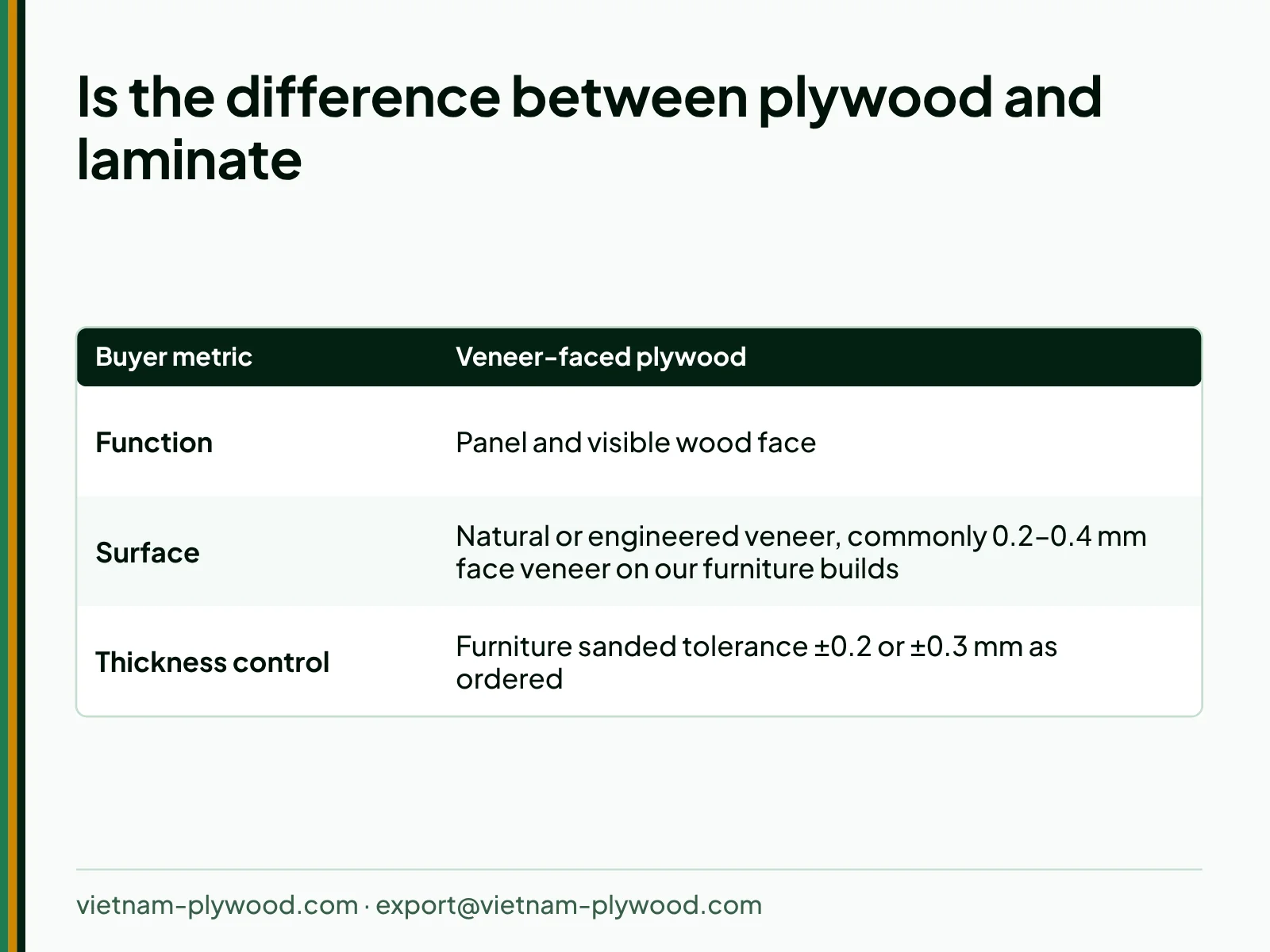
| Buyer metric | Veneer-faced plywood | Decorative laminate on a substrate | Decision by use |
|---|---|---|---|
| Function | Panel and visible wood face | Applied decorative surface plus separate panel | Choose plywood for the substrate; laminate for a specified surface finish |
| Surface | Natural or engineered veneer, commonly 0.2–0.4 mm face veneer on our furniture builds | Printed or solid-colour decorative finish defined by its maker | Choose laminate for repeatable colour or pattern |
| Thickness control | Furniture sanded tolerance ±0.2 or ±0.3 mm as ordered | Finished thickness includes substrate, adhesive and overlay | Check assembled thickness for door and hardware fit |
| Edge detail | Exposed plywood edge can be designed into the component | Edges need a compatible detail or banding | Review cut-edge drawings before ordering |
| Repair and finishing | Veneer can be finished under an agreed finishing system | Follow laminate-maker repair and cleaning instructions | Choose based on maintenance specification |
We do not press medium-density fiberboard (MDF), oriented strand board (OSB), chipboard, blockboard or bamboo panels.
Which HCPLY line fits the panel beneath the finish?
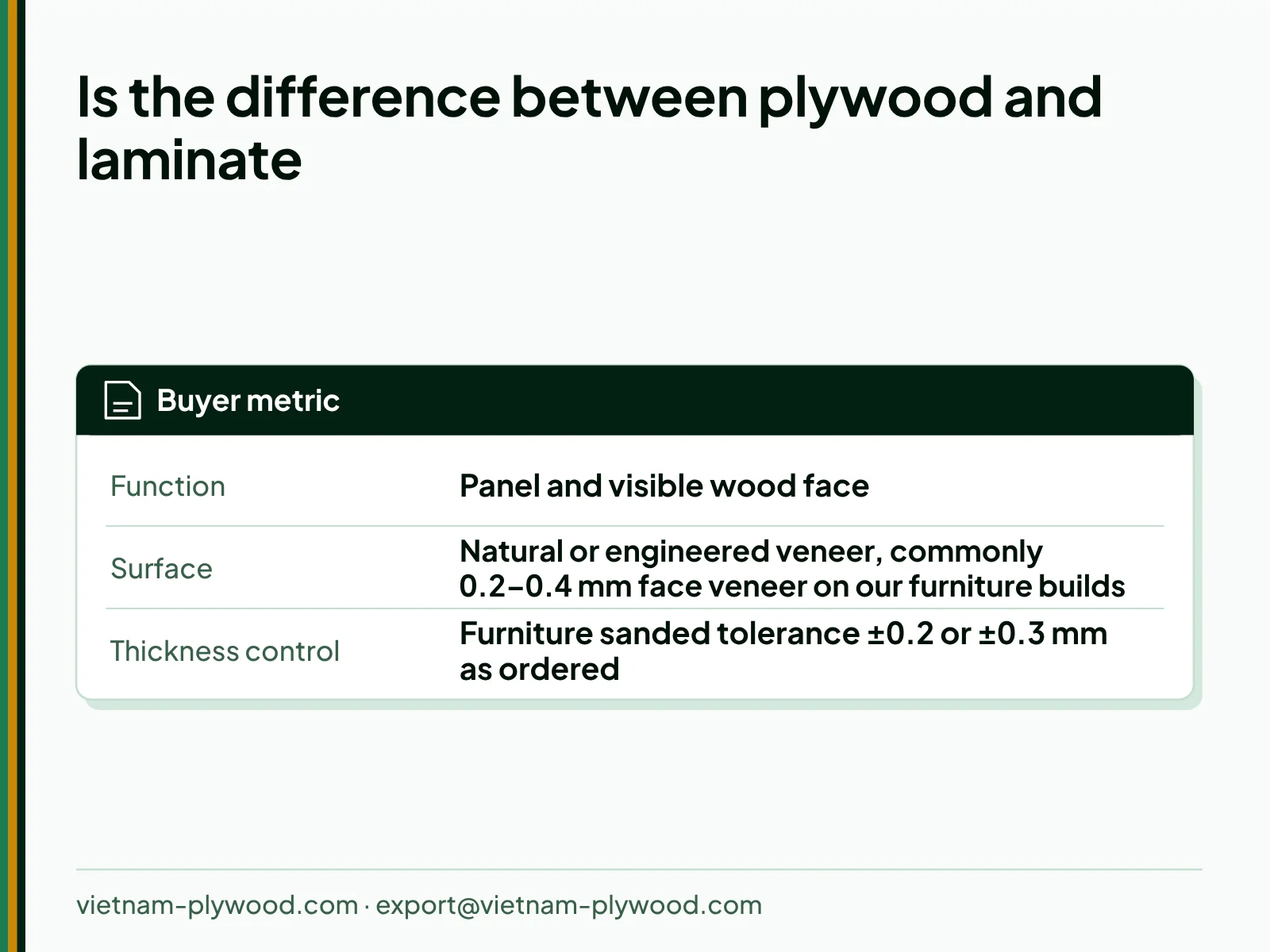
Our furniture line is the first comparison for a cabinet-grade plywood substrate or a visible veneer face. It uses styrax or eucalyptus core, full stitched construction and sanding, with E0 or E1 emission classes specified separately from the glue. The commercial and packing line makes acacia-core, moisture-resistant (MR) glue panels for utility applications. The construction line presses film-faced boards for formwork rather than furniture laminate.
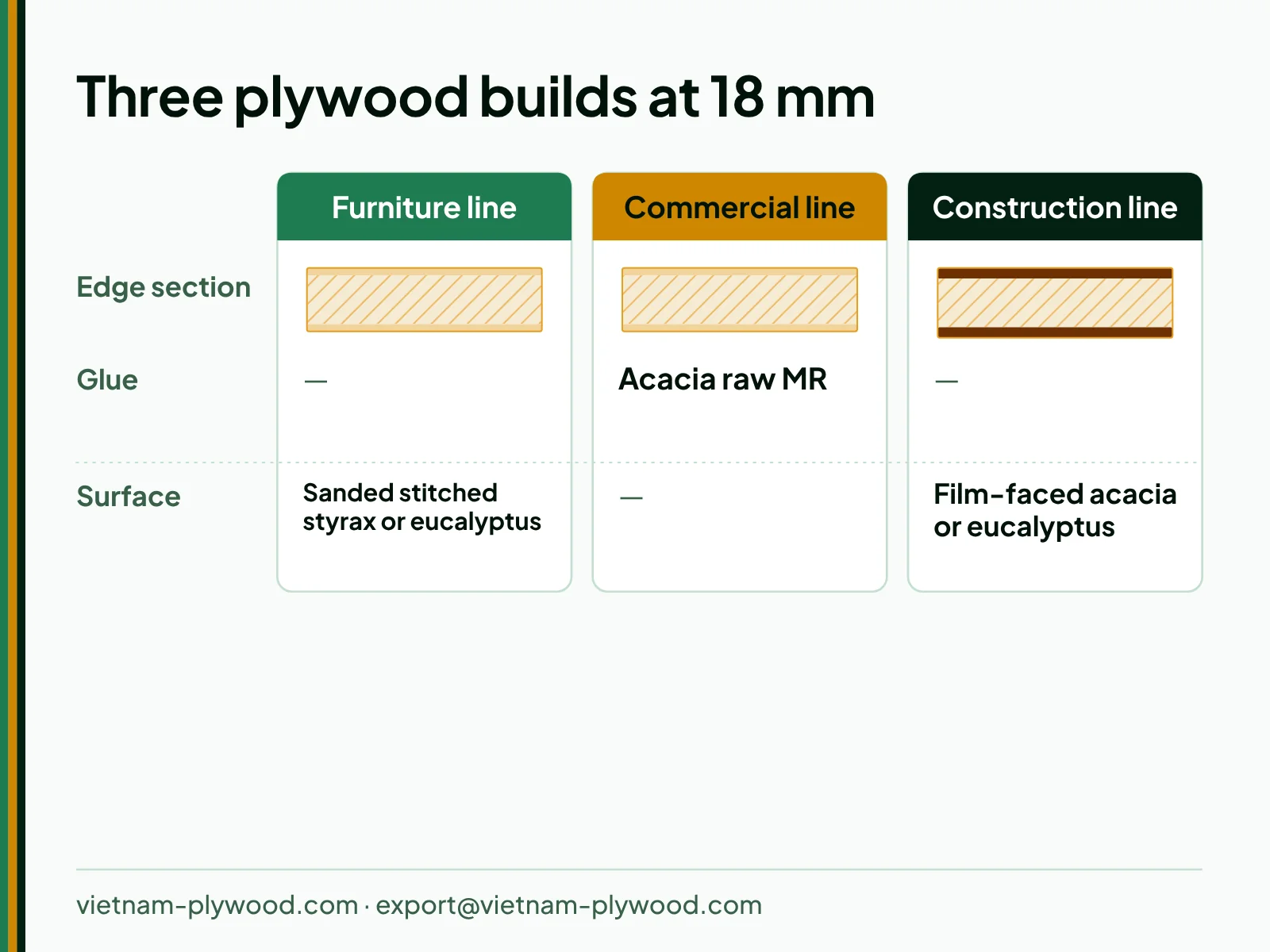
| Line | 18 mm core and finish | Surface preparation | Buyer verdict |
|---|---|---|---|
| Furniture | Styrax or eucalyptus; veneer face such as bintangor, okoume or engineered veneer | Full stitched, sanded; ±0.2 or ±0.3 mm thickness tolerance as ordered | Cabinet substrate or visible furniture face |
| Commercial and packing | Acacia; raw matt face | Unsanded or light-sanded; ±0.5 mm commercial tolerance | Utility backing and packing applications, not a finished decorative face |
| Construction | Acacia or eucalyptus; phenolic or melamine film | Unsanded; ±0.5 mm thickness tolerance | Concrete formwork and jobsite use |
For a decorative plywood order, our furniture line presses the panel; the other two lines build for different service conditions. See the plywood types library and our Vietnam plywood manufacturing overview for related builds.
How should a cabinet maker specify the substrate?
Start with the finished component drawing, then work backward to the substrate.
Our furniture panels cover 3–40 mm thickness, including common 9, 12, 15, 18 and 21 mm orders. Standard sizes include 1220×2440 and 1250×2500 mm, with custom cutting available. The length and width tolerance is ±2 mm.
The face names the product, but density follows its core. A bintangor-faced panel with styrax core should not be costed or loaded as though its entire thickness were bintangor. For different visible veneer choices, compare gurjan and bintangor faces and poplar or engineered veneer alternatives.
Which face, glue and emission fields belong in the order?
A complete furniture plywood specification states the face species and grade, core species, adhesive system and emission class as separate fields. Our face options include bintangor, okoume, engineered veneer, gurjan, pine, poplar, eucalyptus, birch and sapele. A/B face grades apply to the usual veneer choices; birch uses D/E/F grades.
Melamine glue is an MR option with a 12-hour boil specification; phenolic glue is the weather-and-boil-proof (WBP) option with a 72-hour boil specification. Those are glue-system descriptors, not a declaration that the finished board is suited to every wet application. Emission classes E0, E1 and E2 describe a separate performance field. Specify the accepted evidence for the destination market and end use.
If a laminate fabricator plans to bond a further surface, agree on sanding, moisture condition, glue compatibility and a sample lamination trial. Compare acacia and eucalyptus cores when the weight and core choice matter.
Does US emission regulation treat every laminate the same?
No. US rules distinguish decorative overlays from certain wood-veneer laminated products, and they regulate specified composite wood panels. The US Environmental Protection Agency’s 2024 laminated-product implementation guidance explains that non-exempt laminated products became subject to hardwood-plywood requirements from March 22, 2024. The agency states a hardwood-plywood emission limit of 0.05 ppm under Toxic Substances Control Act (TSCA) Title VI.
For US-bound furniture components, identify the actual substrate and any subsequent veneer lamination, then request the applicable third-party emission documentation and traceable lot information. Member-factory CARB P2 documents can be shown with factory details masked, on request. Read the EPA’s regulated-stakeholder questions when defining the compliance route.
What can an inspector check at the producing factory?
An inspector can witness the panel checks that affect downstream lamination: thickness across the sheet, length and width, face condition, sanding uniformity, visible core gaps at cut edges and package identification. The inspection record should match the approved sample and the written purchase specification. It should distinguish a face veneer defect from a core or sanding defect.
Check a representative cut edge against the stated full-stitched core build. Buyers can inspect goods at the producing factory and meet our team at its factory office.
How does core choice affect an 18 mm shipment?
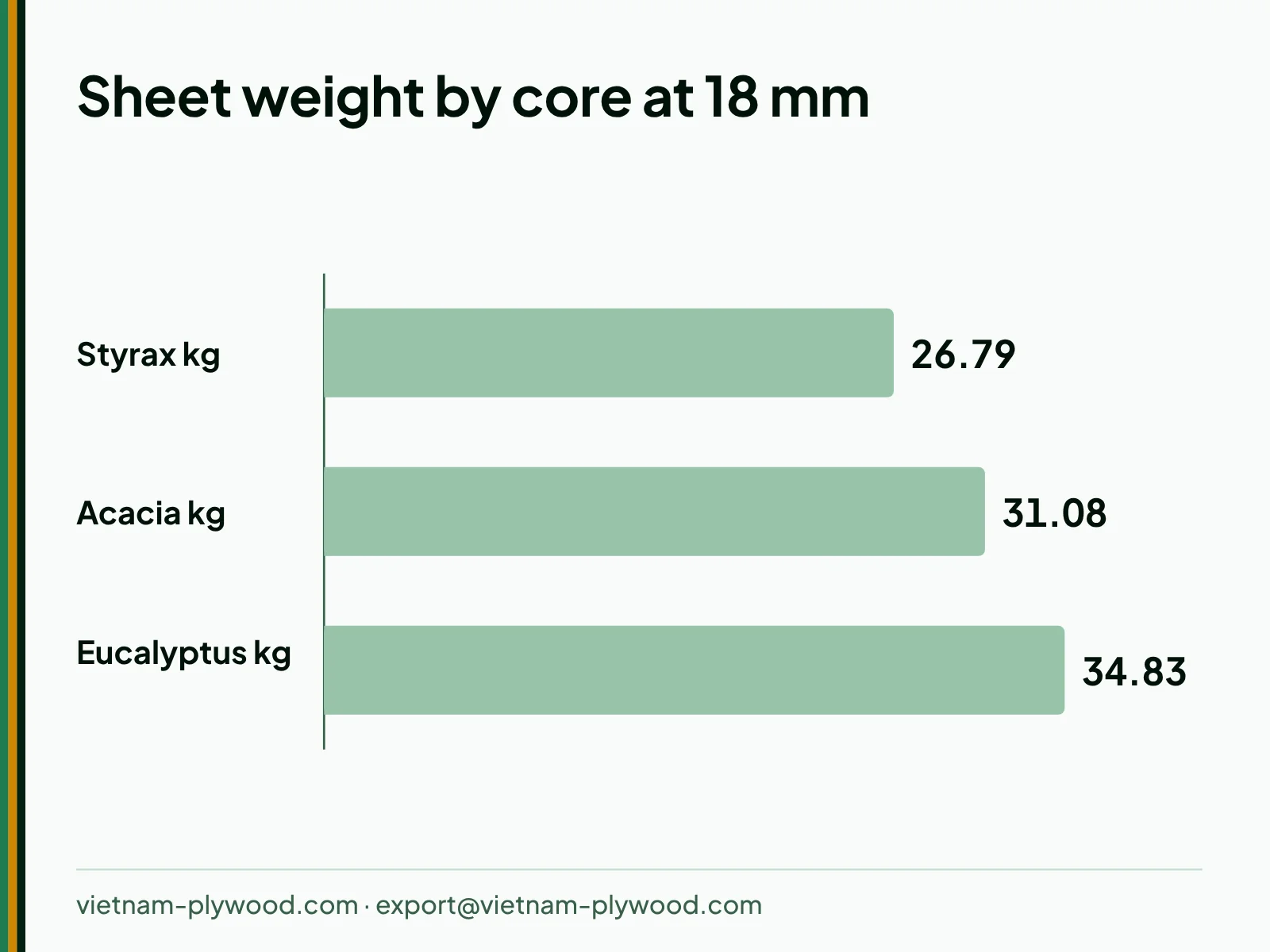
At 18 mm and 1220×2440 mm, an individual styrax-core sheet weighs 26.79 kg, acacia 31.08 kg and eucalyptus 34.83 kg. A full 40HC reference load is 990 styrax sheets at 26.52 t, 880 acacia sheets at 27.35 t or 795 eucalyptus sheets at 27.69 t. These figures exclude film weight and use a 28.5 t payload ceiling.
The minimum order is one 40HC, and specifications can be mixed within the payload limit. Do the mixed-load calculation from each build’s sheet count and weight, rather than multiplying every pallet by the lightest panel’s weight. The container loading calculator covers the full sheet-count question.
Our three factories in Phu Tho and Hai Phong produce orders on the line matching the specification. HCPLY handles specification, on-site quality control, documents and loading, with shipment directly from the producing factory.
What drives the quotation for decorative plywood?
Face selection and grade usually change a decorative plywood quotation first, followed by core construction, sanding requirement, glue system, thickness and order mix. A full-stitched, sanded furniture build requires more face and core preparation than an unsanded utility panel. Decorative laminate sheet prices must be obtained from the separate laminate manufacturer.
For a plywood comparison, the published starting points are from US$350/m³ FOB Hai Phong (October 2026) for furniture plywood and from US$250/m³ FOB Hai Phong (October 2026) for commercial plywood. For a particular veneer grade or laminate-ready substrate, request a quotation against the written specification.
Factory lead time runs 15–45 days from receipt of the 30% deposit; the exact figure depends on order size, line loading and what the contract fixes. The balance is 70% against the scanned bill of lading (B/L), by telegraphic transfer (T/T) or irrevocable letter of credit (L/C) at sight. We ship FOB Hai Phong, or CFR (CNF) or CIF to your port.
Which documents travel with the plywood?
The export paperwork connects the contracted plywood specification with the goods loaded for the buyer. The commercial invoice identifies the goods and sale terms; the packing list records packages and quantities.
The shipment document package includes the commercial invoice, packing list, B/L, certificate of origin (EUR.1 for EU lots), phytosanitary and fumigation papers, insurance under CIF, and agreed certificate documents. EU lots also have the EUTR/EUDR file set. After loading, the draft shipping documents come to you for approval. FSC, CARB P2, ISO 9001 and CE documents belong to the member factories and are shown with factory details masked, on request.
If a buyer is planning several plywood types, the multiple plywood types overview and commercial plywood export checklist help define the specification and paperwork.
How should the first trial container be planned?
Plan the first trial container around the finished cabinet component, the agreed plywood substrate and the buyer’s surface-application process. Request samples for machining and lamination tests before approving the bulk face and sanding standard. Samples cost nothing: a first-time buyer pays the courier, and that charge comes off the first confirmed order.
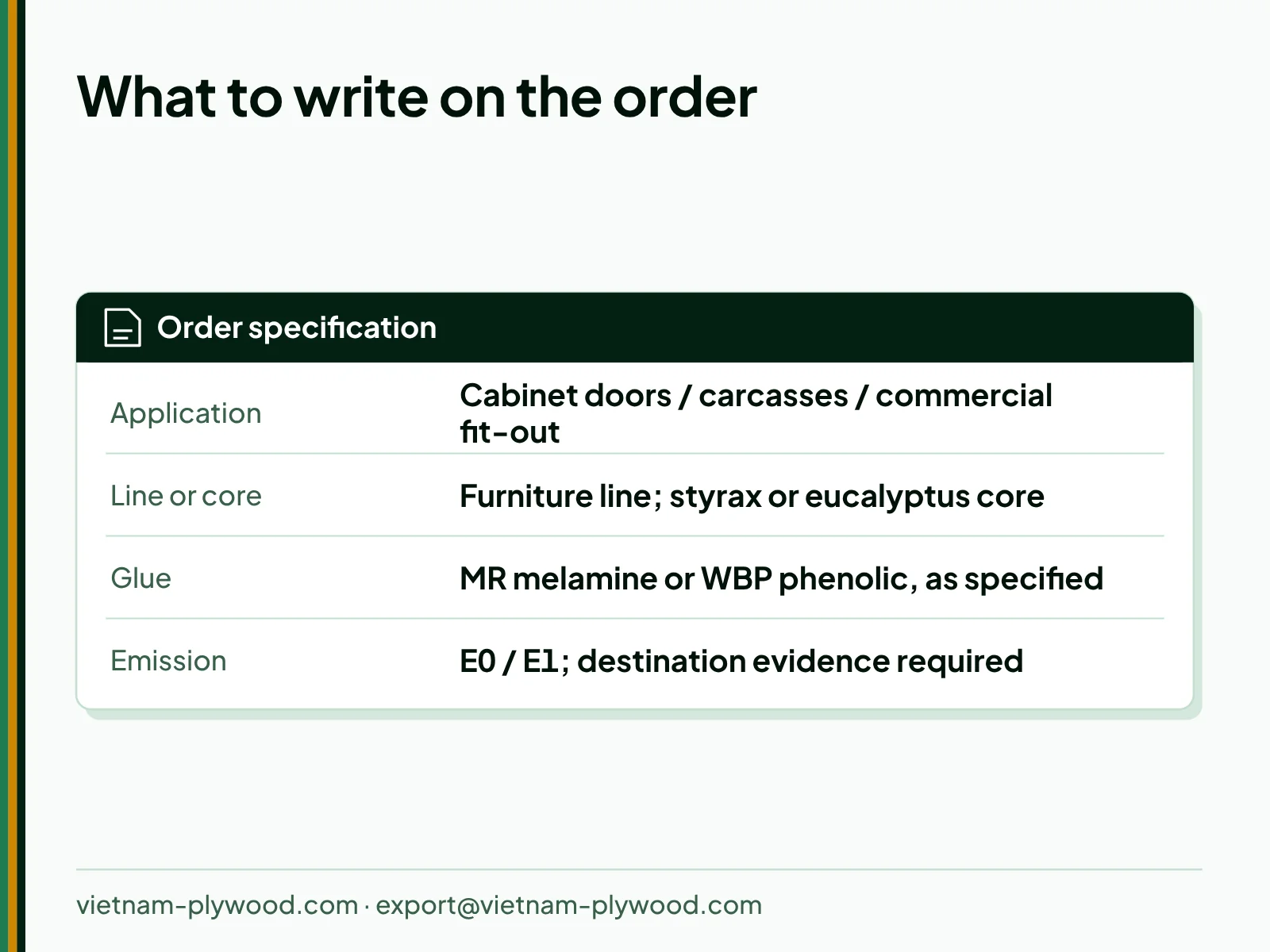
Send Lucy the intended use, face reference, substrate build, target tolerance and discharge port.
Application: Cabinet doors / carcasses / commercial fit-out
Line or core: Furniture line; styrax or eucalyptus core
Glue: MR melamine or WBP phenolic, as specified
Emission: E0 / E1; destination evidence required
Face and grade: Veneer species and A/B (birch D/E/F), or raw matt
Thickness and tolerance: ___ mm; ±0.2 or ±0.3 mm as ordered
Size: ___ × ___ mm
Quantity: ___ sheets / pallets; mixed 40HC details
Destination port: ___
Next step: plan a trial container with Lucy at export@vietnam-plywood.com.