





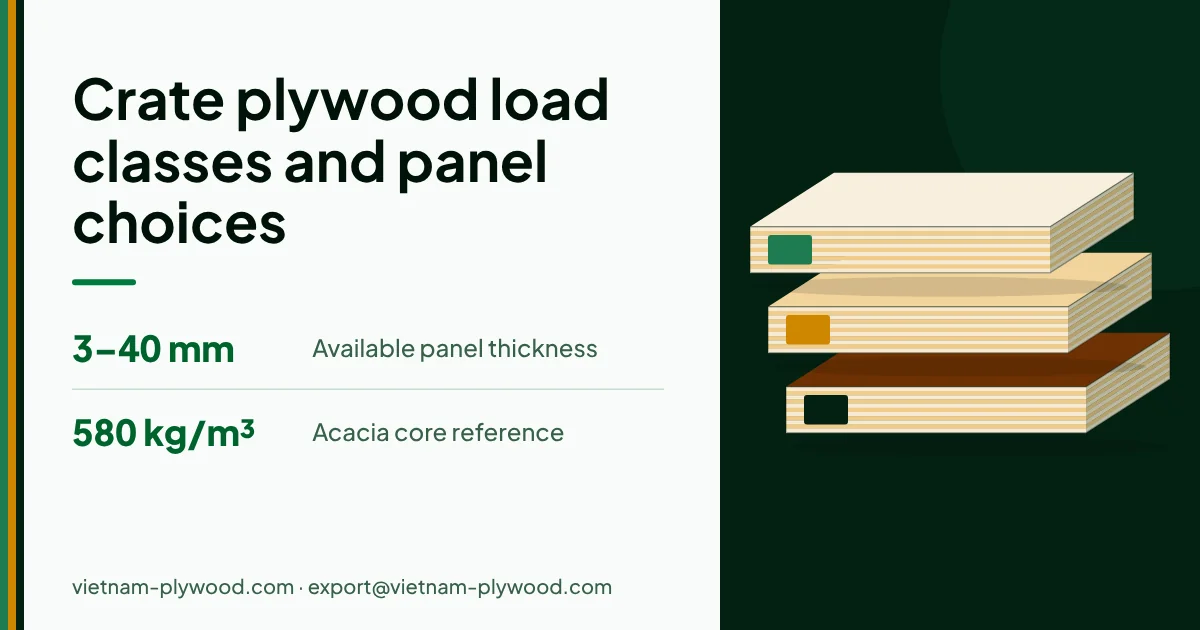
Crate plywood for HCPLY’s commercial and packing line starts with acacia-core panels, MR glue and a thickness selected for the crate’s load path. A wrong build can split at a fastener, delay packing or leave an industrial shipment exposed to damage. We specify the panel around its job in the finished crate, then cut the ordered parts at the producing factory.
What plywood is used for crates and pallets?
Crate plywood is a pressed veneer panel used for crate walls, lids, partitions and selected pallet components. Our commercial and packing line presses acacia-core panels with moisture-resistant (MR) melamine glue and unsanded or light-sanded faces. For pallet decks, specify support spacing and concentrated loads separately from the crate’s side-wall specification. The packaging plywood overview explains the wider product family.
A plywood crate combines flat panels with a frame or other supports designed by the crate maker. The panel keeps contents enclosed and spreads contact over a surface; framing, blocking and fasteners transfer the load. A wall panel that survives handling is not automatically a suitable forklift-bearing deck. The drawings should identify which pieces carry weight and which simply enclose it.
Which build suits each crate load class?
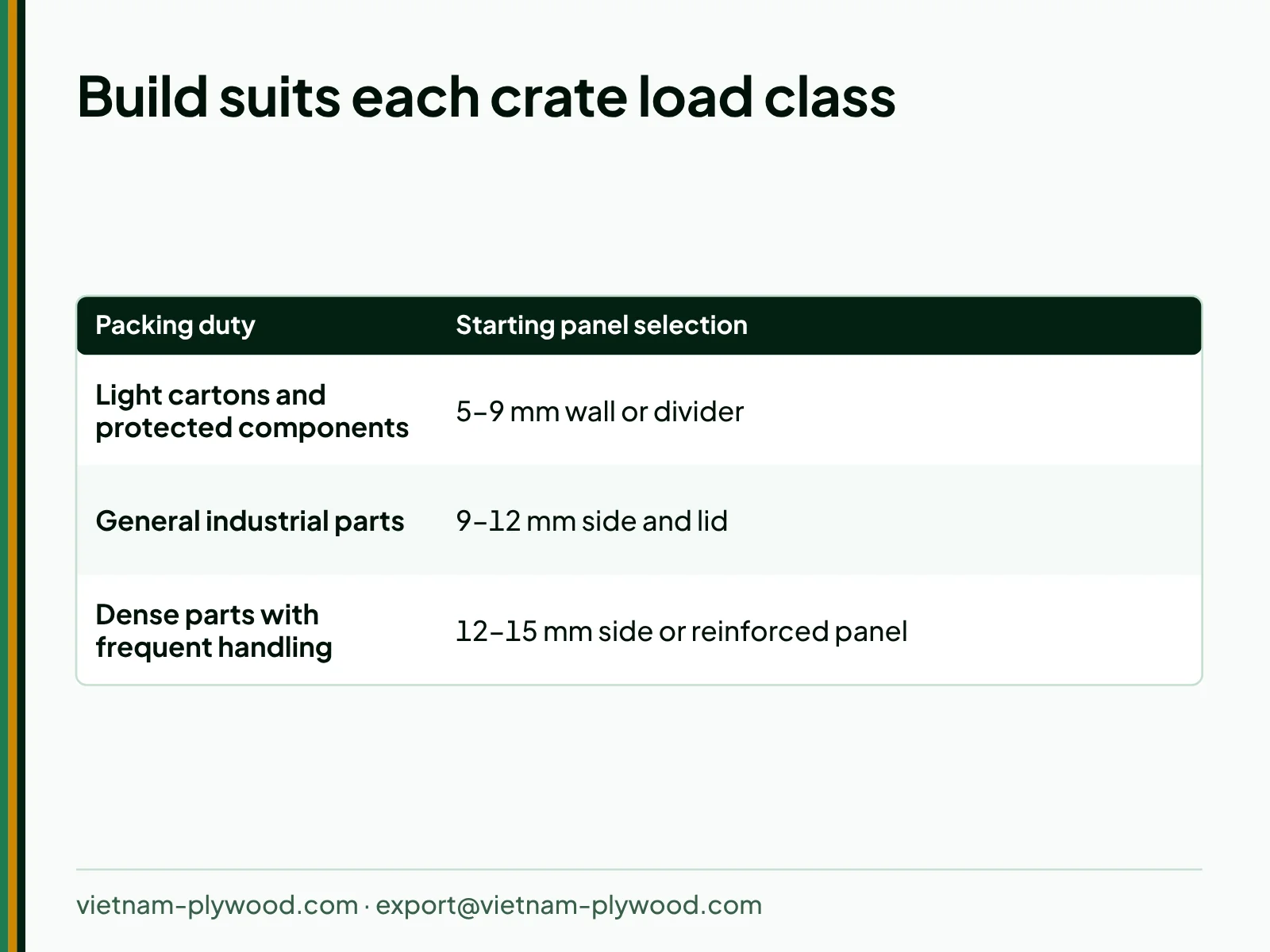
The load-class ladder below is a specification starting point, not a certified weight rating. Each class describes the handling situation; the crate designer must calculate the loaded assembly, frame, fasteners and supports. HCPLY can press the panel build shown, while the finished crate’s safe working load requires separate design evidence.
| Packing duty | Starting panel selection | Core and glue | Critical design check |
|---|---|---|---|
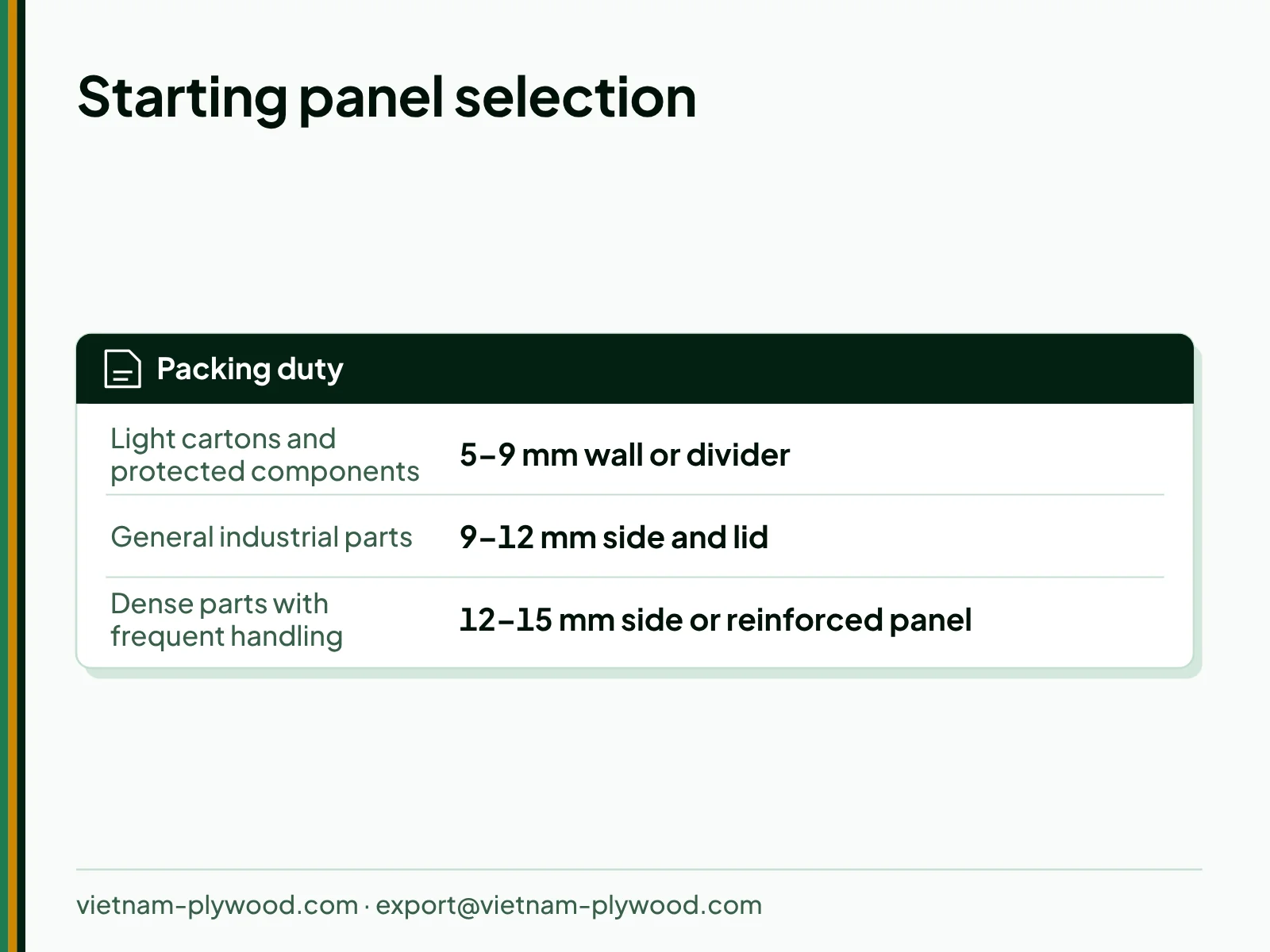
| Light cartons and protected components | 5–9 mm wall or divider | Acacia, MR | Edge fastening and support spacing |
| General industrial parts | 9–12 mm side and lid | Acacia, MR | Racking and local impact at corners |
| Dense parts with frequent handling | 12–15 mm side or reinforced panel | Acacia, MR | Screw lines, bracing and panel deflection |
| Machinery enclosure | 15–18 mm wall where the design calls for it | Acacia, MR | Machine restraint, skid design and lifting points |
| Pallet deck or bearing surface | 15–21 mm candidate, engineered against span | Acacia, MR | Point loads, forklift entry and deck support |
These thickness ranges are design proposals for discussion, not tested capacities for a finished crate. A heavier machine can need a stronger base and restraints even when its enclosure walls remain comparatively thin. Conversely, a broad, unsupported wall may need additional stiffeners although its contents are light. Share a sketch with load positions and handling directions before finalizing thickness.
What thickness does a plywood packing crate need?
Thickness follows unsupported span, fastener placement, load concentration and the panel’s role. For light enclosures, a thinner panel can work with closely spaced supports; a deck or long wall needs a separate bending check. Start with the table’s range and validate the actual crate geometry before placing an order.
The packing-line thickness tolerance is ±0.5–1.0 mm as ordered. Commercial panels use ±0.5 mm, and length and width tolerance is ±2 mm. A nominal 12 mm crate wall specified at ±1.0 mm has a different minimum accepted thickness from one ordered at ±0.5 mm. Write the tolerance next to each part rather than assuming a single rule for all pieces.
For an 18 mm panel, the core veneer thickness of 1.4–2.0 mm produces 11–13 plies. Ply count alone cannot tell a buyer whether a panel will hold a fastener near a void. Inspect the cross-section and the actual screw or nail position as well as the measured thickness. Request a trial assembly when fastening is a critical failure mode.
Which glue and core should crate plywood have?
Our packing build uses an acacia core at 580 kg/m³ and MR glue. Acacia is the reference core for our commercial and packing line; the density follows the core, regardless of the decorative face name. MR melamine glue is associated with a 12-hour boil specification, while phenolic water-boil-proof (WBP) glue has a 72-hour boil specification. These are glue descriptions, not a rating for a finished crate left outdoors.
Glue and formaldehyde emission must appear as separate fields in the purchase specification. E0, E1 and E2 describe emission classes; none is a glue name. If the destination contract calls for an emission class or a specific test report, put that requirement on the order. Do not substitute a face veneer name for a core specification.
When does a crate need a commercial build?
Choose a commercial build when the buyer requires a more controlled surface or thickness acceptance than the basic packing specification. The commercial and packing line presses both; the distinction belongs in the written order and inspection plan. It does not automatically raise the finished crate’s load capacity.
| Production line | Build for an 18 mm requirement | Intended use and decision |
|---|---|---|
| Our commercial and packing line | Acacia core, MR glue, unsanded or light-sanded; packing tolerance ±0.5–1.0 mm or commercial ±0.5 mm | Packing for basic enclosure; commercial where tighter panel acceptance matters |
| Our furniture line | Styrax or eucalyptus core, full stitched, sanded, E0/E1; ±0.2 or ±0.3 mm as ordered | Cabinet or furniture parts needing a finer finish, usually unnecessary for crates |
| Our construction line | Acacia or eucalyptus core, phenolic or melamine film, unsanded; ±0.5 mm | Formwork and film-faced applications rather than ordinary crate walls |
The furniture line uses a full-stitched core, while packing construction can be specified by the accepted joint arrangement. In descending core-construction order, the available descriptions are full stitched; stitched outer layers with edge-trimmed inner layers; finger-jointed; and loose-laid. Put the permitted construction in the inspection sheet so a lower-cost joint pattern cannot be mistaken for the ordered build.
Why use plywood instead of solid wood for export crates?
Plywood provides large, flat panels from bonded veneers, allowing the crate shop to cut repeatable walls and lids. Cross-oriented layers can reduce directional movement compared with a comparable solid-wood board, although the assembled crate still needs suitable bracing. A flat sheet also allows a cutting plan with fewer separate wall boards.
There is a distinct export-treatment question. The International Plant Protection Convention’s 2021 ISPM 15 publication explains that its raw-wood packaging scope excludes processed wood packaging such as plywood: IPPC, Regulation of wood packaging material in international trade. A crate made entirely of qualifying processed plywood is different from one with solid-wood skids, runners or battens. The solid-wood components must be evaluated under the destination’s applicable wood-packaging rules.
For European Union imports, the European Commission’s wood-packaging requirements page, citing Regulation (EU) 2016/2031, excludes packaging made entirely from processed plywood and specifies treatment and marking for regulated wood packaging: European Commission wood-packaging requirements. This distinction matters to a buyer ordering plywood sides and separate timber supports. It does not replace checking the destination’s requirements for the assembled package.
Can crate and pallet panels be cut before loading?
Yes. Custom cutting is available for ordered panel dimensions, so the packing shop can receive specified blanks rather than only full sheets. Send a part schedule identifying the side, end, lid, divider and deck pieces with finished sizes and quantities. State whether the dimensions describe finished blanks or allowance for the crate shop’s final trimming.
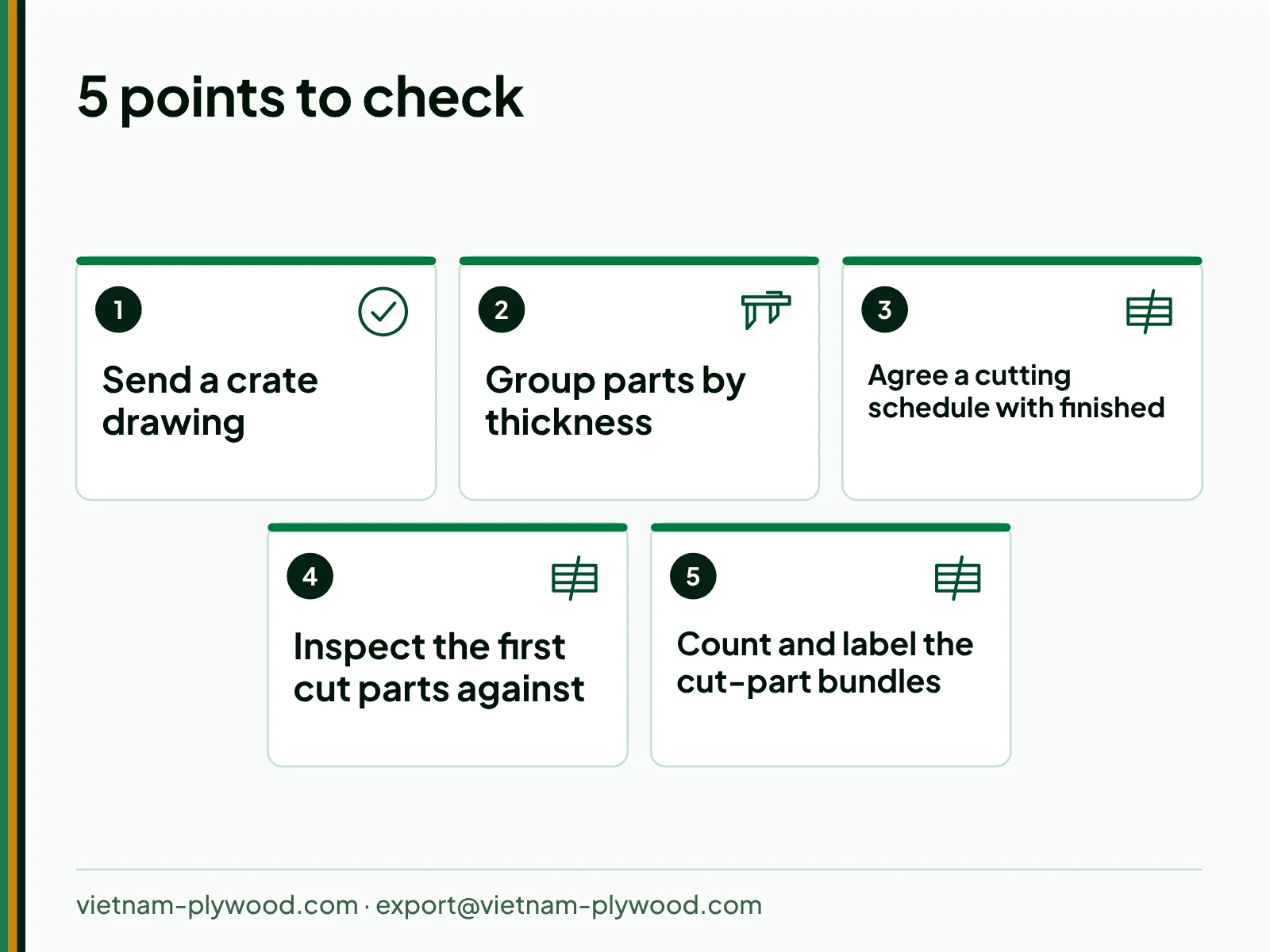
- Send a crate drawing with the panel’s function marked on each part.
- Group parts by thickness, core, glue, face and required tolerance.
- Agree a cutting schedule with finished length and width for each blank.
- Inspect the first cut parts against the approved drawing and the ±2 mm length/width tolerance.
- Count and label the cut-part bundles against the packing list before container loading.
Our packing plywood product specification is the starting point for panel details. The single-supplier product range explains how different panel specifications can be organized for an export order.
How should mixed crate panels fit a container?
A 40HC container has a 28.5 t payload limit in our loading reference, and specifications can be mixed within that limit. For full 1220×2440 mm, 18 mm acacia panels, the reference is 880 sheets, 47.15 m³ and 27.35 t. That full-load reference leaves 1.15 t beneath the payload limit before considering any changes in packaging or mixed specifications.
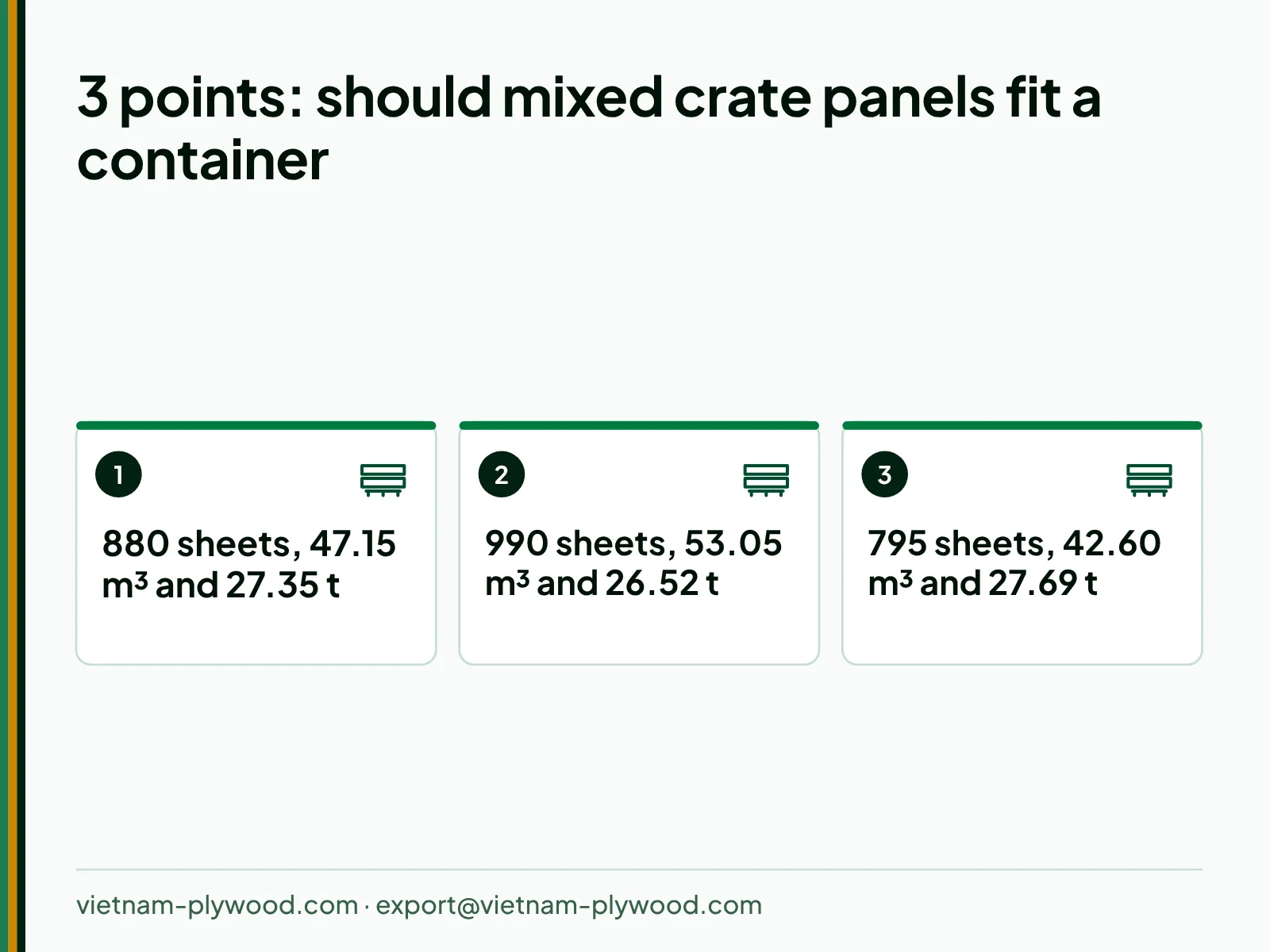
An 18 mm styrax-core full load is 990 sheets, 53.05 m³ and 26.52 t; eucalyptus-core is 795 sheets, 42.60 m³ and 27.69 t. These are separate homogeneous loading examples, not interchangeable pallet counts. The acacia reference uses 16 pallets, while styrax uses 18 and eucalyptus 15. The container loading calculations own the complete sheet-count question.
What should a buyer inspect at the producing factory?
The buyer can witness thickness measurements, cross-section checks and a count of finished cut parts at the producing factory. For crate panels, focus on core continuity near fastener lines, edge condition and whether the delivered blanks match the crate drawing. Our on-site quality control follows the approved order specification rather than an assumed generic crate grade.
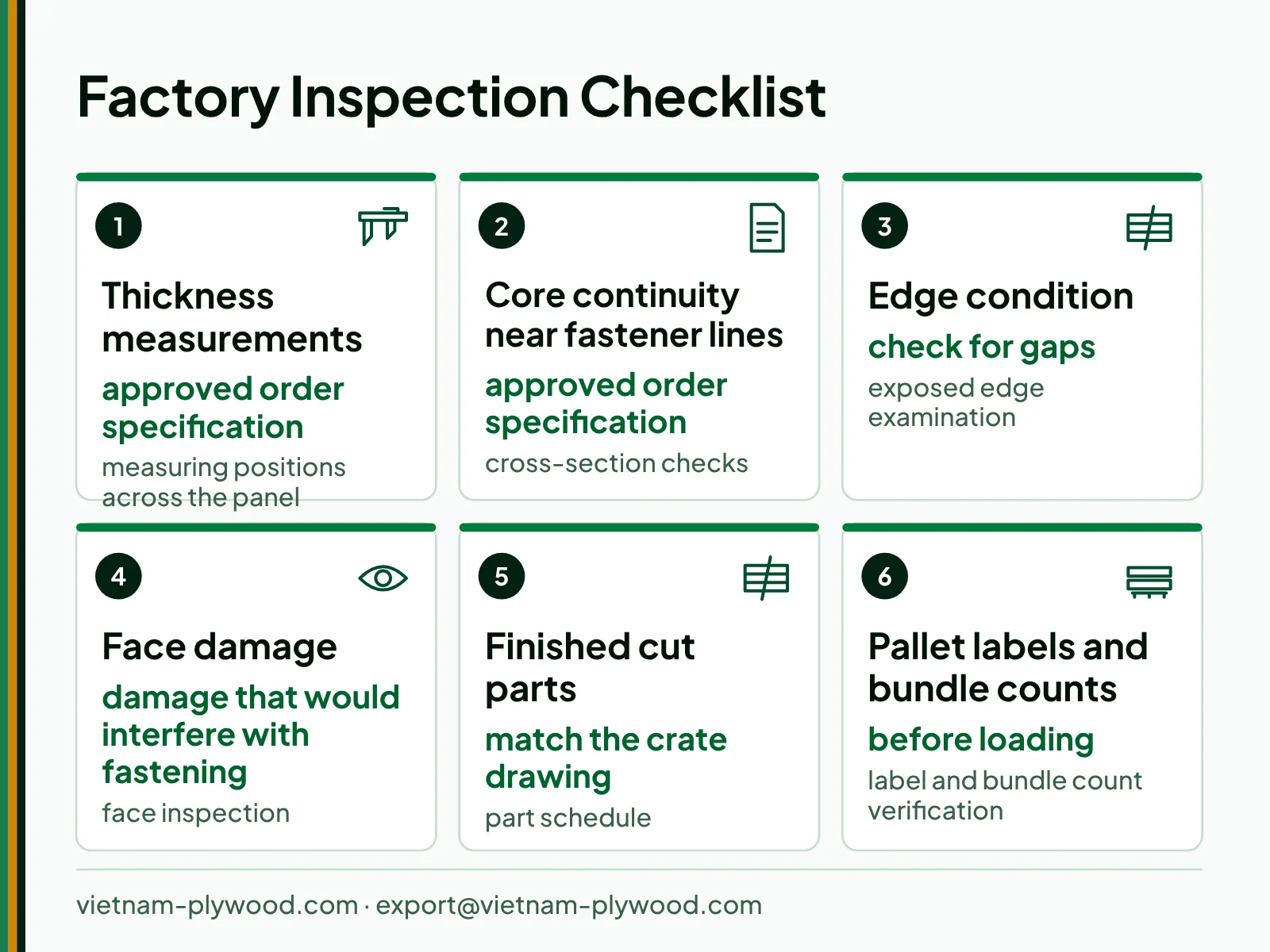
A useful inspection sequence begins with a representative stack. Measure several positions across the panel, examine exposed edges for gaps and check the face for damage that would interfere with fastening. Compare cut parts against the part schedule, then verify pallet labels and bundle counts before loading. If the buyer’s design requires a screw-pull or bending result, agree the method and acceptance report before production.
What changes the quote and shipment plan?
Core construction and thickness are the strongest starting price drivers, followed by the permitted tolerance, cutting yield, face requirement and glue specification. A thicker, tightly specified commercial panel costs more to produce than a thinner basic packing build because it uses more veneer and tighter selection. Extensive cut-to-size work also changes material yield and handling. Request a quotation against the written specification rather than a generic crate-panel price.
The minimum order is one 40HC; one container can carry several specifications as long as the payload limit holds. Factory lead time runs 15–45 days from receipt of the 30% deposit; the exact figure depends on order size, line loading and what the contract fixes. The remaining 70% is paid on the scan of the bill of lading, by T/T, or by irrevocable sight L/C. We ship FOB Hai Phong, or CFR (CNF) or CIF to your port.
Samples cost nothing: a first-time buyer pays the courier, and that charge comes off the first confirmed order. Our commercial and packing line is part of the furniture and commercial plywood capacity of up to 100 containers a month; construction plywood is up to 140. HCPLY has three member factories in Phu Tho and Hai Phong, with each order produced on the appropriate line and shipped directly from it.
What details belong on the crate plywood order?
A usable crate plywood order identifies the part’s role, panel build and acceptance checks. Include the destination port because the crate shop’s assembly design and any solid-wood components may need destination-specific documentation. The crate’s load class alone is insufficient to define the panel.
For export, the shipment document set includes the commercial invoice, packing list, bill of lading (B/L), certificate of origin, phytosanitary and fumigation papers, insurance under CIF, and agreed certificate or test documents. European Union lots also use EUR.1 where applicable and the EUTR/EUDR file set. Member-factory FSC, CARB P2, ISO 9001 and CE documents are shown with factory details masked, on request; their applicability belongs to the ordered factory and build.
Use the following fields as the request to Lucy. Include a crate drawing and the proposed handling method alongside this specification.
Application: crate wall / lid / divider / pallet deck; load class and support drawing
Line or core: commercial and packing line / acacia core
Glue: MR melamine; state any agreed alternative requirement
Emission: E0 / E1 / E2 or specified destination requirement
Face and grade: matt or named face; agreed face grade
Thickness and tolerance: ___ mm; ±___ mm
Size: finished blank L × W ___ mm; cutting schedule attached
Quantity: ___ pieces by part; total ___ m³ / container plan
Destination port: ___
Request the crate plywood specification sheet from Lucy at export@vietnam-plywood.com with the drawing and proposed quantities.