

Most import buyers use “cabinet plywood” and “furniture plywood” interchangeably when placing orders. This is a costly mistake. The terms point to genuinely different spec combinations — and ordering the wrong one means delamination, failed formaldehyde tests, or rejected shipments at customs.
This guide breaks down what you need to know about the actual technical differences, the face species that qualify for each use, and why matt plywood is neither cabinet nor furniture grade — it is a raw substrate that comes before both.
🪵 What “Cabinet Plywood” Actually Means
Cabinet plywood is not a separate product category in the Vietnamese manufacturing system. It is a specification combination applied to standard plywood panels that makes them suitable for enclosed, high-contact interior environments like kitchen cabinets, wardrobe boxes, and bathroom vanity units.
The three defining requirements for cabinet-grade plywood:
- Emission: E0 (≤0.5 mg/L formaldehyde)
Kitchen and bathroom cabinets are enclosed volumes. Formaldehyde released inside a closed cabinet box accumulates faster than in an open room environment, as confirmed by indoor air quality studies from Wageningen University (2022). E0 emission grade — equivalent to CARB Phase 2 at the federal standard level — provides the safety margin required for these confined spaces.
E1 emission (≤1.5 mg/L) is legally acceptable for open furniture in most markets. Inside a cabinet box, E1 is three times the formaldehyde load of E0. Professional cabinet manufacturers in Germany, South Korea, and Japan specify E0 as the floor, not the ceiling.
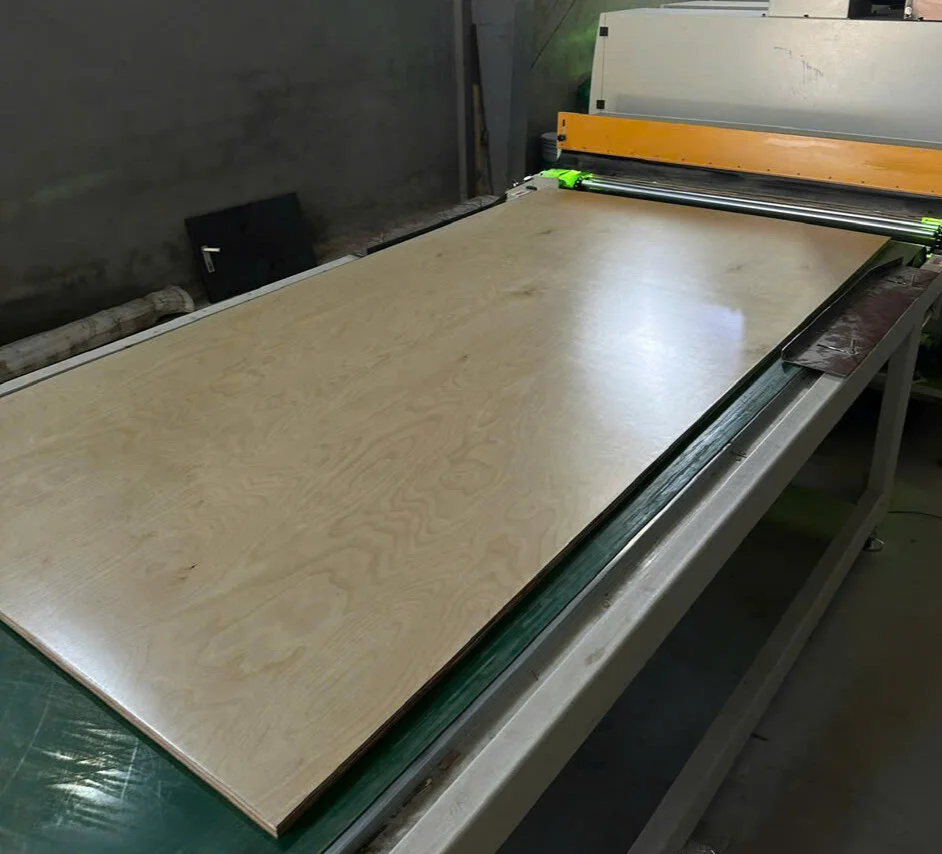
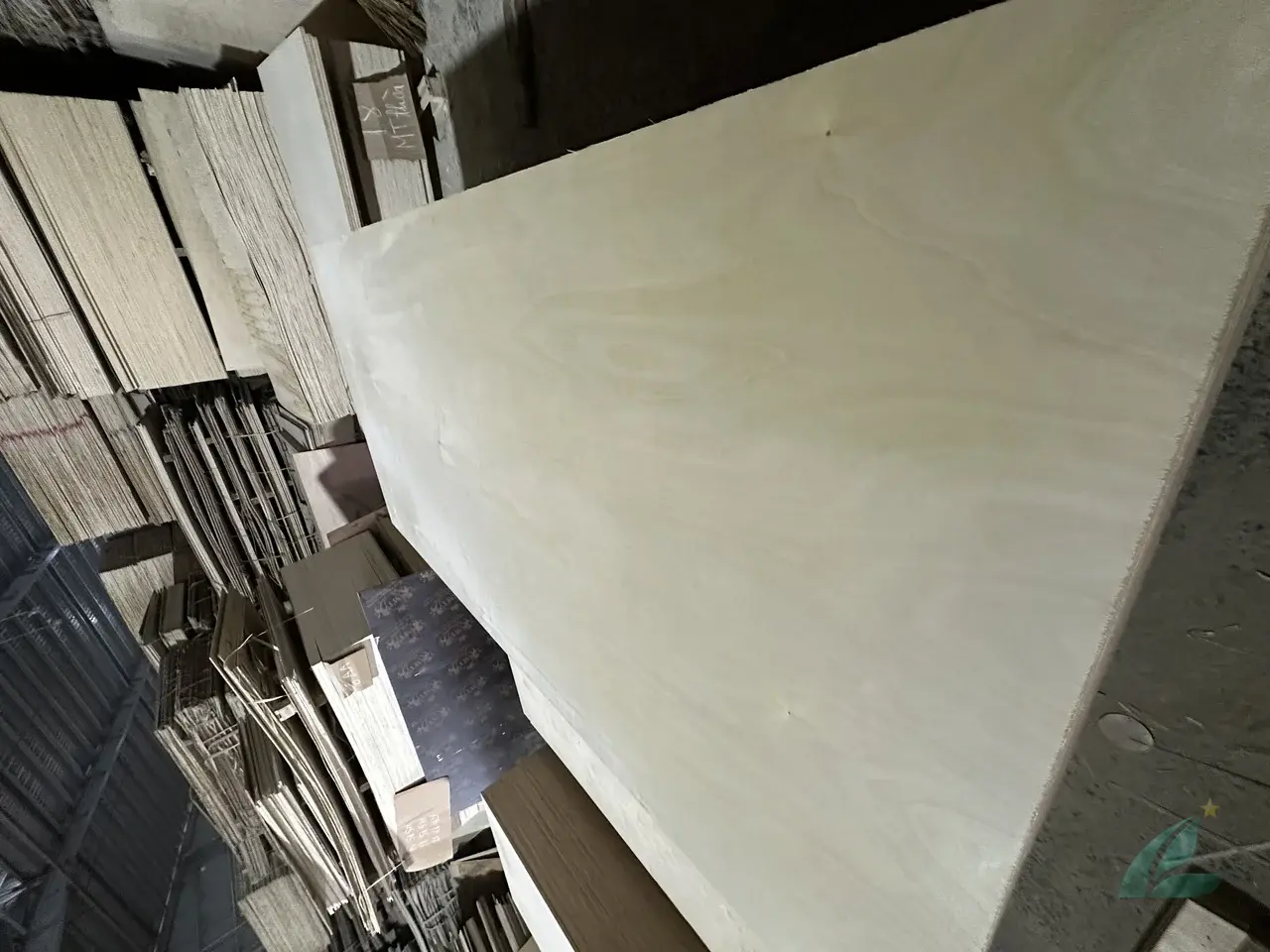
- Face: Birch D/E/F or EV (Engineered Veneer)
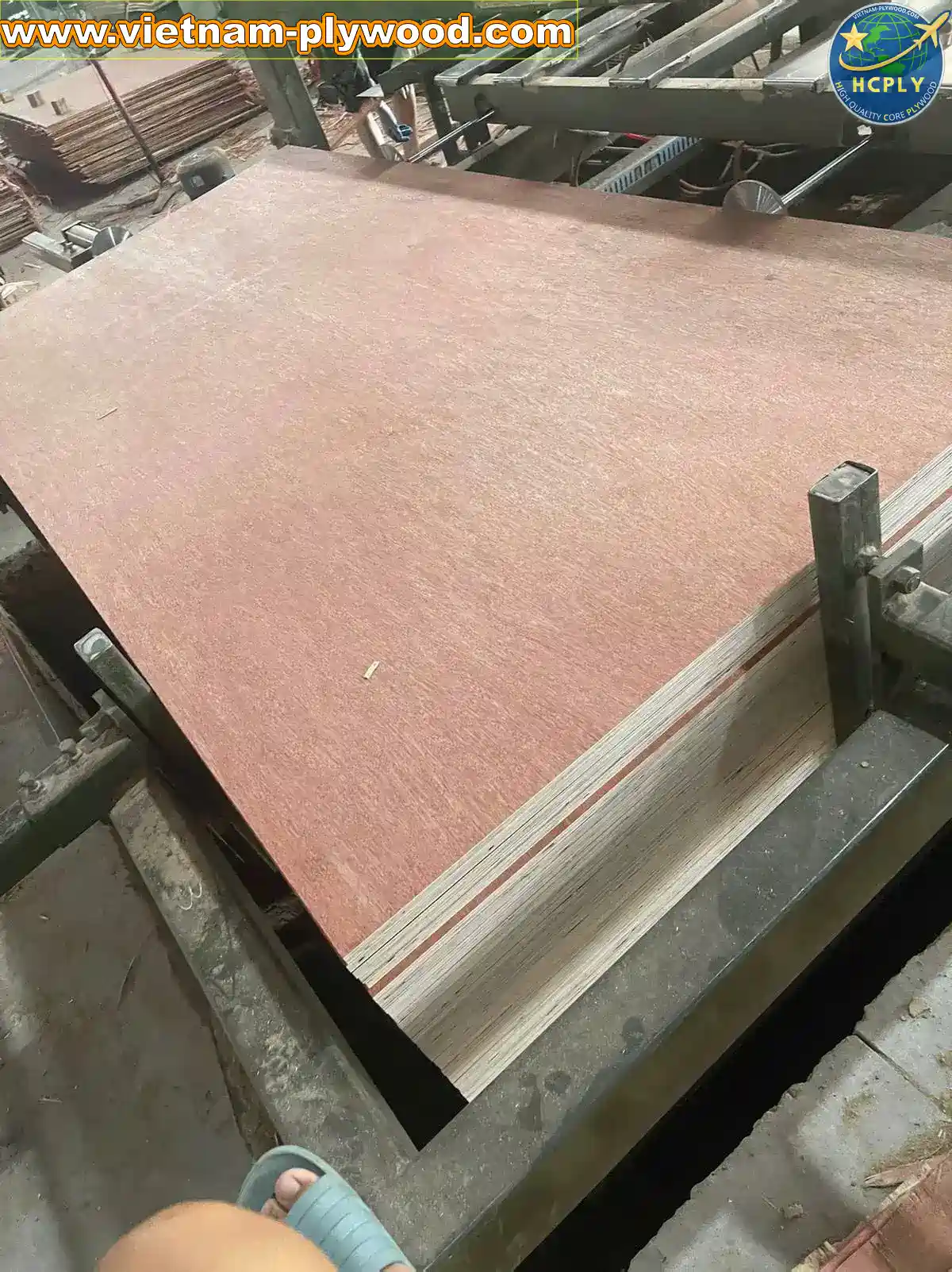
Birch and EV face veneers are the two standard choices for cabinet-grade work. Both offer smooth, consistent surfaces that accept paint, lacquer, and edge-banding without pre-treatment. Bintangor and okoume face veneers — common for general furniture plywood — have coarser grain and higher knot frequency that requires additional sanding before finishing. Cabinet manufacturers pay for precision; they do not absorb secondary processing costs.
Birch (grade D/E/F in the Vietnamese grading system — note: A/B/C grades do not exist in this range) delivers natural grain with tight pore structure. EV delivers machine-perfect consistency at a slightly lower cost per unit. Both require full sanding at the factory before shipment.
- Core: Full-stitched, E0 emission standard throughout
A birch face bonded to an acacia loose-lay core with E2 melamine is not cabinet plywood. The core veneers must be stitched (sewn) to eliminate gaps that weaken screw-holding and contribute to long-term deformation under load. The adhesive used throughout — face-to-core and core-to-core — must also meet E0 emission levels, not just the face glue.
Key Insight: E0 emission grade must apply to the entire panel, not just the face veneer. Ordering “birch face + E0” without specifying the core adhesive standard is a common sourcing error that produces test failures when the full panel is tested by the importing country’s certification body.
🛋️ Furniture Plywood: Broader Specs, Lower Barrier
Furniture plywood is the parent category. Cabinet plywood is a sub-category. All cabinet plywood is furniture plywood. Not all furniture plywood is cabinet-grade.
The key differences in furniture plywood specs:
| Spec | Cabinet Plywood | General Furniture Plywood |
|---|---|---|
| Emission | E0 (≤0.5 mg/L) | E0 or E1 (≤1.5 mg/L) |
| Face species | Birch D/E/F or EV | Birch, EV, okoume, bintangor A/B |
| Sanding | Full calibration sanding | Sanding standard or light sand |
| Core construction | Full-stitched | Stitched outer + edge-jointed inner acceptable |
| Core species | Styrax or eucalyptus | Styrax, eucalyptus, or acacia |
| Glue | Melamine (MR) with E0 threshold | Melamine (MR) with E0 or E1 |
| Typical market | EU, US, Japan, South Korea | EU, Asia-Pacific, Middle East |
A bedroom wardrobe panel using okoume face with E1 emission is legitimate furniture plywood that works perfectly for its application. The okoume surface takes lacquer well enough for visible panels. The E1 emission level is acceptable in a room with normal ventilation. The cost savings over a full E0 birch spec can be 15–20% per CBM, depending on core species.
The selection decision is driven by the end-use environment and the target market’s regulatory requirements — not by a supplier’s product label.
Contact HCPLY Now for furniture plywood specifications
🔲 Matt Plywood: Raw Substrate, Not a Finished Grade
Matt plywood causes more specification confusion than any other product in this discussion. It is the most commonly misidentified product in the cabinet and furniture plywood category.
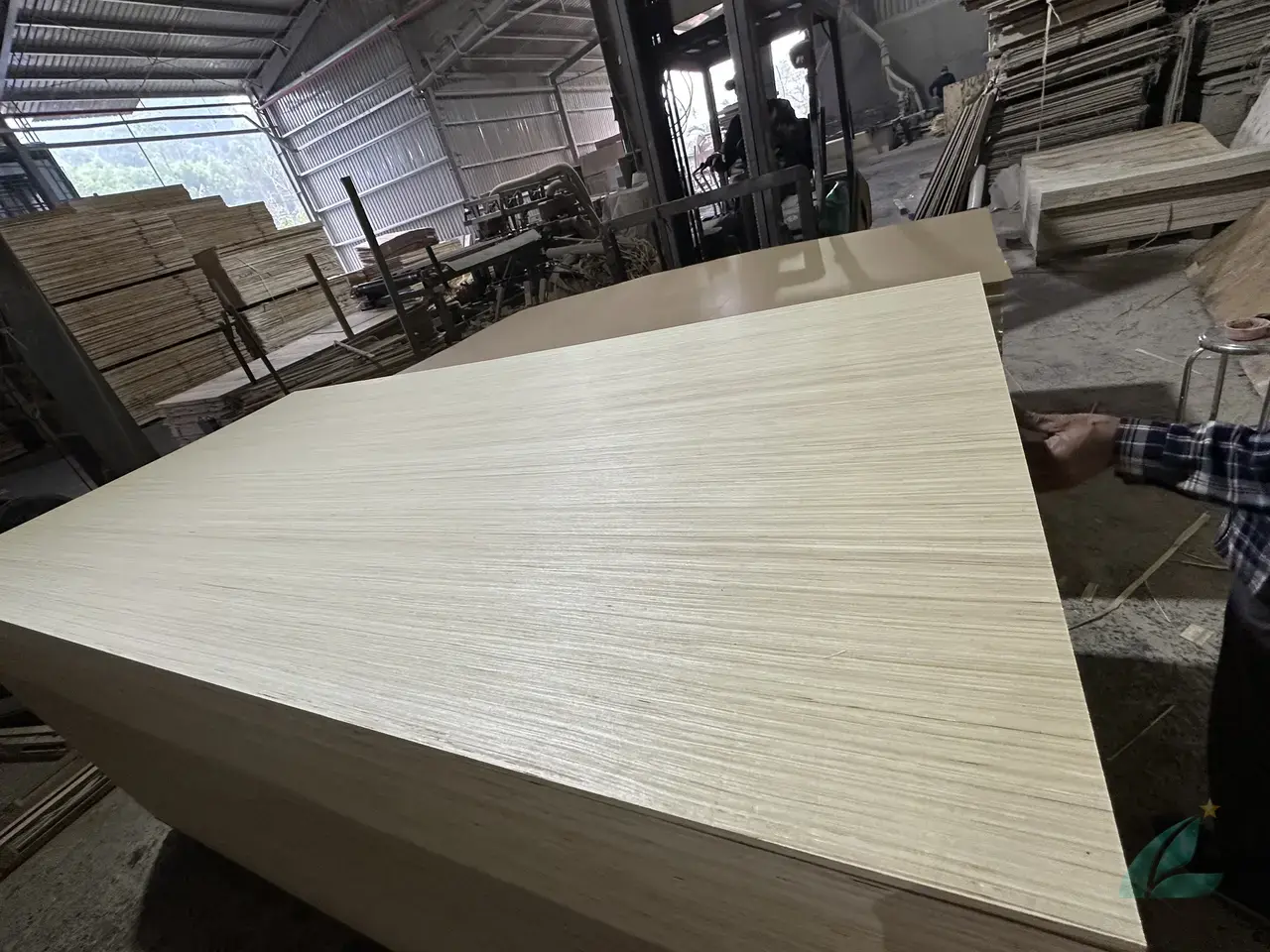
Matt plywood is unfaced. There is no veneer on the face layers. The surface you see is raw core material — typically styrax, eucalyptus, or acacia — with no finish, no sanding for appearance purposes (only calibration sanding for thickness tolerance), and no decorative function.
Matt plywood is purchased by:
- HPL lamination factories that bond high-pressure laminates onto the raw surface
- Melamine paper processors that press melamine-impregnated paper to the face
- PVC wrapping operations that apply PVC film to the sanded substrate
- Veneer overlaying facilities that apply thin sliced veneer to the panel
In all these cases, the matt plywood is an intermediate input material. The downstream processor applies the decorative layer. The resulting panel — after lamination — can then be sold to furniture and cabinet manufacturers.
“Matt plywood for cabinets” is therefore a process description, not a product description. You are buying a substrate that will become cabinet material after your own processing operation adds the surface layer.
⚠️ Important: If a supplier lists “matt plywood” as a furniture or cabinet product without specifying the lamination process you will apply to it, clarify this immediately. Shipping raw matt substrate to a buyer expecting a finished furniture panel creates unresolvable disputes at customs and delivery.
⚙️ Core Species Selection: The Hidden Variable
The face veneer receives most attention in cabinet plywood discussions. The core species determines structural performance, weight, and long-term dimensional stability — all of which matter more to cabinet makers than the face.
Vietnam’s three core species, and their practical implications for cabinet applications:
Styrax core (480–500 kg/m³) The standard choice for premium cabinet plywood from Northern Vietnam. Styrax is lightweight, which reduces shipping weight per container, and produces a white cross-section that matches the visual expectation buyers have when cutting or machining cabinet panels. Full-stitched styrax core achieves the screw-holding strength cabinet hinges and slides require without the weight penalty of eucalyptus. HCPLY’s premium furniture production facility (Facility 1, Phu Tho Province) uses styrax as the primary core species for E0 birch and EV cabinet panels (HCPLY production data, 2026).
Eucalyptus core (650–750 kg/m³) The high-density alternative. Eucalyptus core delivers stronger screw retention — relevant for cabinet applications with heavy hardware — and greater resistance to compression at load-bearing points. The weight premium (approximately 150–200 kg per CBM vs styrax) increases shipping cost and reduces the number of pallets that fit within the 28.5 MT payload limit of a 40HC container. Appropriate for buyers in markets that specify minimum density in their cabinet panel standards, such as certain South Korean and Japanese procurement requirements.
Acacia core (~580 kg/m³) Acacia is the commercial-grade core species. It is darker in color, less dimensionally stable under humidity cycling, and typically used with edge-jointed or loose-lay construction in lower-cost panels. Acacia core is not standard for cabinet-grade plywood. A birch or EV face on an acacia loose-lay core does not produce cabinet-grade plywood — the face spec and core spec must be matched.
“The single most common sourcing error we see is buyers specifying E0 emission and birch face, then accepting acacia loose-lay core to save cost. When the cabinet box is cut on-site, the internal layers are visible. The gaps in the core are visible. The installer knows immediately, and the buyer has no recourse. Core specification is non-negotiable for cabinet grade.” — Lucy, International Sales Manager, HCPLY (6+ years plywood export experience)
📊 Glue vs Emission: Two Different Spec Dimensions
Cabinet plywood purchasing decisions consistently conflate glue type and emission standard. These are separate specifications controlled by different production processes.
Glue type determines moisture resistance:
- Melamine (MR) — passes 12-hour boiling test. Adequate for interior furniture and cabinets in dry environments
- Phenolic (WBP) — passes 72-hour boiling test. Required for exterior, marine, and formwork applications
Emission standard determines formaldehyde output:
- E0: ≤0.5 mg/L — required for cabinet, healthcare, educational environments
- E1: ≤1.5 mg/L — acceptable for general interior furniture
- E2: ≤5.0 mg/L — exterior or industrial use only (not acceptable for EU/US interior applications)
Cabinet plywood uses Melamine (MR) glue — not phenolic — because interior cabinet environments do not require 72-hour boil resistance. The emission standard is E0. These two specifications are independent: you can have MR glue with E0 emission, or MR glue with E1 emission. The emission grade depends on the formaldehyde content of the specific resin used in the MR adhesive, controlled at the glue manufacturing stage.
A supplier specification that lists “WBP glue + E0” for cabinet plywood is technically inconsistent. WBP phenolic glue contains higher base formaldehyde levels that make E0 achievement significantly more expensive and less common for interior applications. For standard kitchen cabinet panels, MR + E0 is the correct specification.
🌍 Market Requirements by Destination
Emission standards for cabinet and furniture plywood are not uniform across import markets. The regulatory floor varies by country:
| Market | Minimum for Cabinet Interiors | Certification |
|---|---|---|
| European Union | E1 (≤1.5 mg/L) minimum; E0 preferred | CE marking for structural products |
| United States | CARB Phase 2 (≡ E0, ≤0.05 ppm) | CARB P2 certification mandatory |
| Japan | F4-star (≡ E0 equivalent, JAS standard) | JAS certification |
| South Korea | E0 (≤0.5 mg/L) for sealed interior | KS F 3101 applicable |
| India | E1 acceptable; E0 for premium segment | BIS IS:303 standard |
| Middle East | E1 commonly accepted | Per importer specification |
For export buyers shipping cabinet plywood to the US, CARB Phase 2 certification is legally mandatory under the Formaldehyde Standards for Composite Wood Products Act (Federal Register, 2016). This is not a preference specification — failure to comply results in customs seizure and financial penalties for the importer. HCPLY maintains CARB P2 certification for birch and EV panel production.
For European buyers, E0 certification is not currently legally mandated for all cabinet applications, but the European Commission regulation on formaldehyde in furniture is progressively tightening. The practical recommendation for EU buyers placing orders for 2026 production is to specify E0 as the standard rather than E1 to avoid re-sourcing when the regulation threshold shifts.
Get a Free Quote for E0 or CARB P2 cabinet plywood
🏭 How HCPLY Produces Cabinet-Grade Plywood
HCPLY manages a dedicated premium furniture production facility in Phu Tho Province, Northern Vietnam. This facility operates separately from the commercial and film-faced production lines, with processes calibrated for furniture and cabinet specifications.
The production sequence for a standard E0 birch cabinet panel:
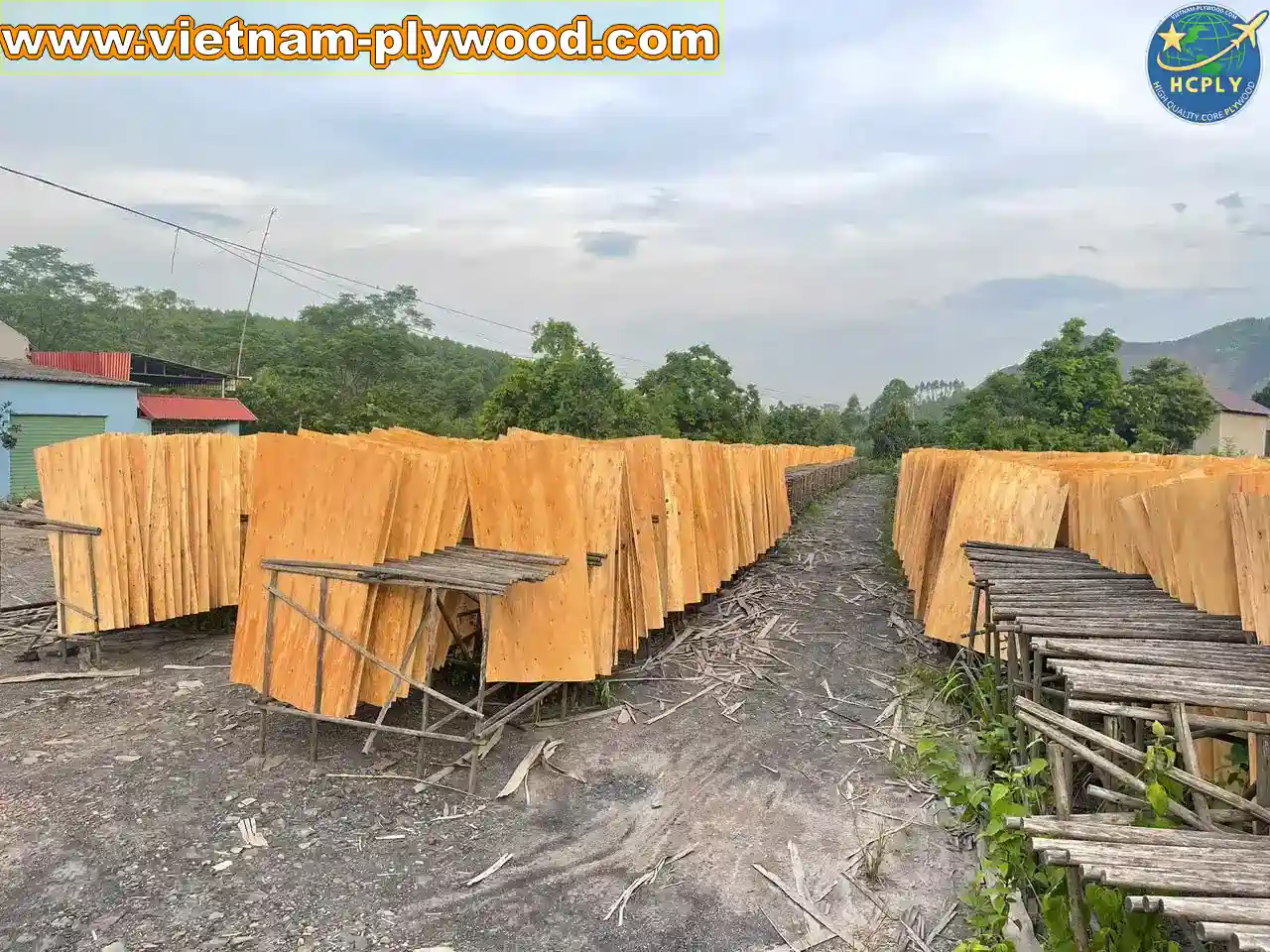
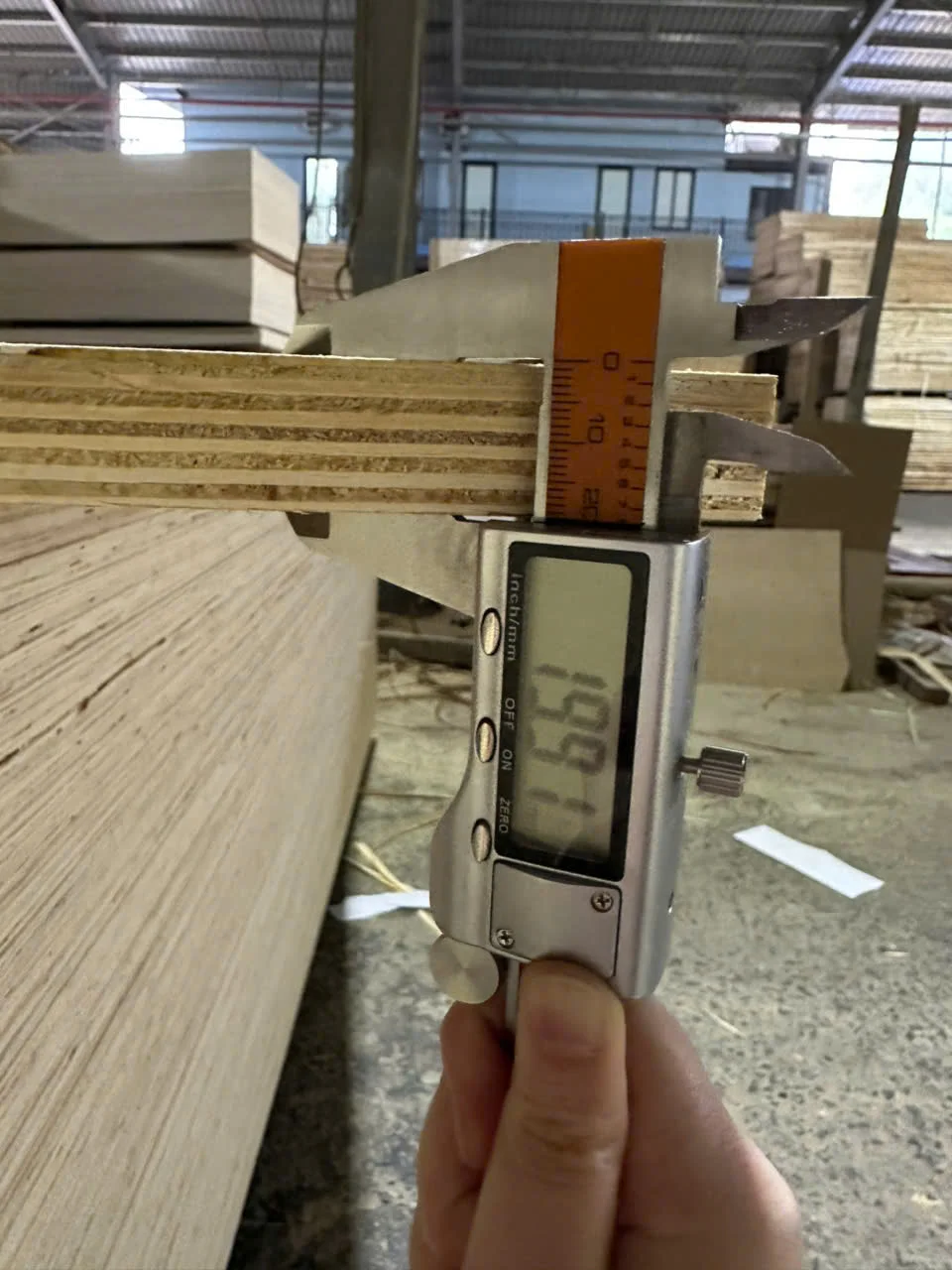
- Core veneer preparation — Styrax or eucalyptus logs are rotary-peeled to 1.3mm veneer sheets. Sheets are dried to 6–8% moisture content.
- Core construction — Full-stitching (machine-sewn) applied to all core layers. No gaps, no overlaps. This is the construction standard that distinguishes cabinet-grade from commercial-grade core.
- E0 emission standard application — Low-formaldehyde melamine resin applied to core and face glue lines. Resin batch tested before production run.
- Face veneer layup — Birch D/E/F or EV face applied to both sides at 0.2–0.4mm thickness.
- Hot pressing — Temperature and pressure parameters set for melamine MR adhesive. Dwell time calibrated to panel thickness.
- Calibration sanding — Wide-belt sander calibrates thickness to ±0.3mm tolerance. Final finish sanding for face smoothness.
- Quality inspection — Thickness, moisture (target 8–12%), surface defect grading, edge inspection.
- Emission testing — Desiccator test per relevant standard. Results accompany shipment documentation.
For cabinet manufacturers purchasing at scale, this production traceability is not a marketing feature — it is the audit evidence required by EU and US retailers’ supply chain compliance programs.
Learn more about HCPLY’s quality control processes and certifications.
✅ How to Specify Cabinet Plywood Correctly
When placing a purchase order for cabinet plywood, specify these five elements explicitly:
Face: Birch D/E/F or EV (Engineered Veneer)
Face thickness: 0.2–0.4mm
Core: Full-stitched styrax (or eucalyptus if high-density required)
Glue: Melamine (MR)
Emission: E0 (≤0.5 mg/L) — or CARB P2 for US market
Sanding: Both faces, calibrated ±0.3mm
If you are purchasing matt plywood for downstream lamination, specify:
Type: Matt plywood (unfaced substrate)
Core: Styrax or eucalyptus
Construction: Full-stitched or stitched outer + edge-jointed inner
Emission: E0 or E1 per your lamination process requirements
Sanding: Calibrated ±0.3mm (substrate flatness critical for HPL bonding)
The EV Plywood Vietnam and Birch Plywood Vietnam product pages provide full specification tables for standard cabinet-grade panels from HCPLY. The Matt Plywood Vietnam page covers substrate specifications for lamination buyers.
✅ Conclusion
Cabinet plywood and furniture plywood describe overlapping but distinct specification sets. Cabinet plywood requires E0 emission grade, a birch or EV face, full-stitched core, and calibration sanding — all applied to a panel intended for enclosed, enclosed-air environments. General furniture plywood accepts E1 emission, a broader range of face species, and less stringent core construction for applications where air exchange is not restricted.
Matt plywood is neither. It is an unfaced substrate that becomes cabinet or furniture material only after downstream lamination processing. Ordering matt plywood expecting a finished cabinet panel is a sourcing error with no clean resolution at destination.
HCPLY’s premium furniture production facility produces E0 birch and EV panels with full-stitched styrax and eucalyptus core. Minimum order is one 40HC container. Lead time 15–20 days from order confirmation.
Get a Free Quote for Cabinet-Grade Plywood from HCPLY — no commitment, factory-direct pricing.