

Acacia core plywood is the most cost-efficient core produced in Northern Vietnam — and the most misunderstood. Buyers see “budget grade” and assume low quality across the board. The reality is different: acacia core is the correct technical choice for film-faced formwork, packing crates, and commercial panels where density, not furniture-grade smoothness, drives the specification.
This guide explains exactly what acacia core plywood is, where it performs well, where it falls short, and how to order the right spec from a factory.
🌳 What Is Acacia Core Plywood?
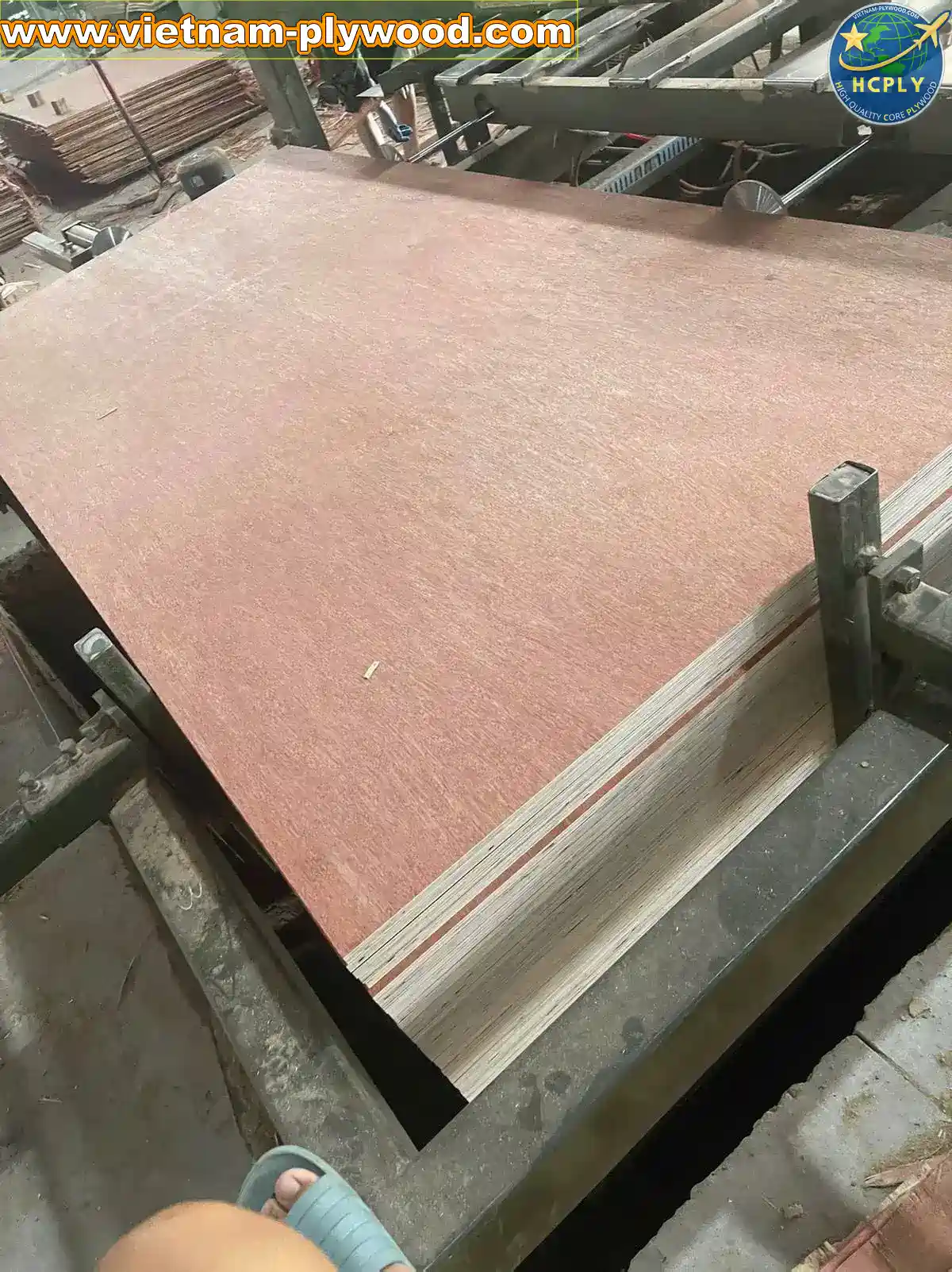
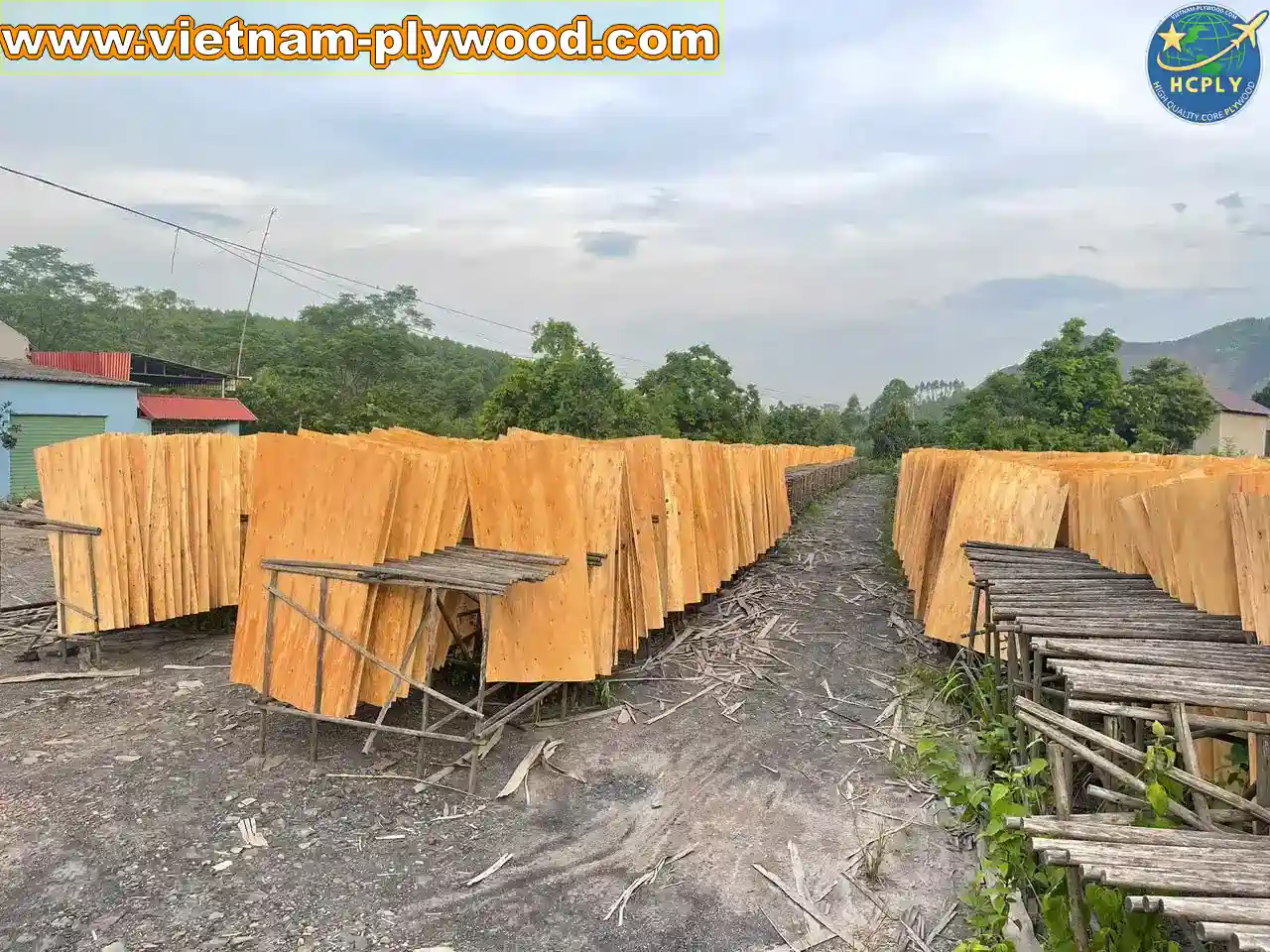
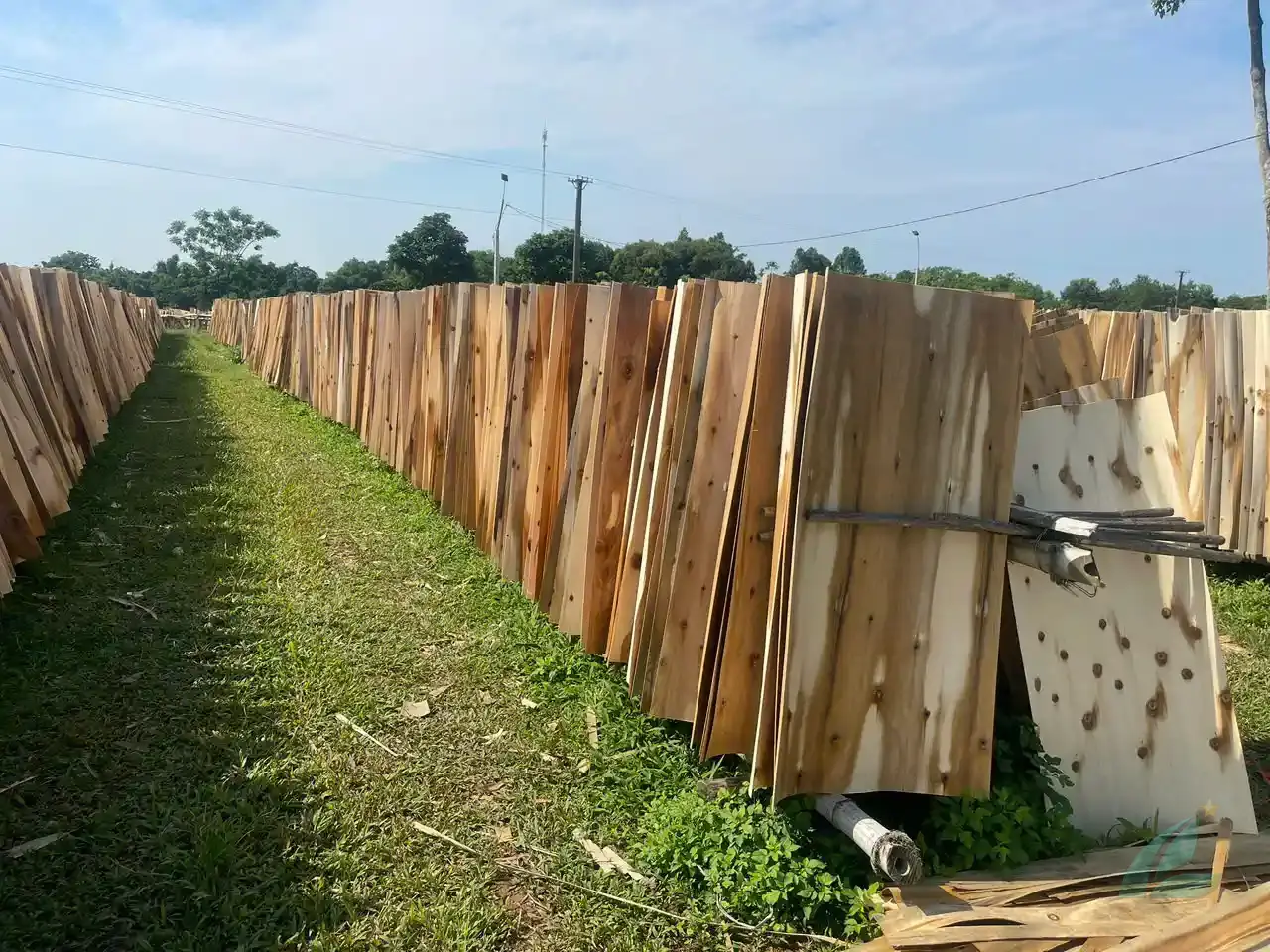
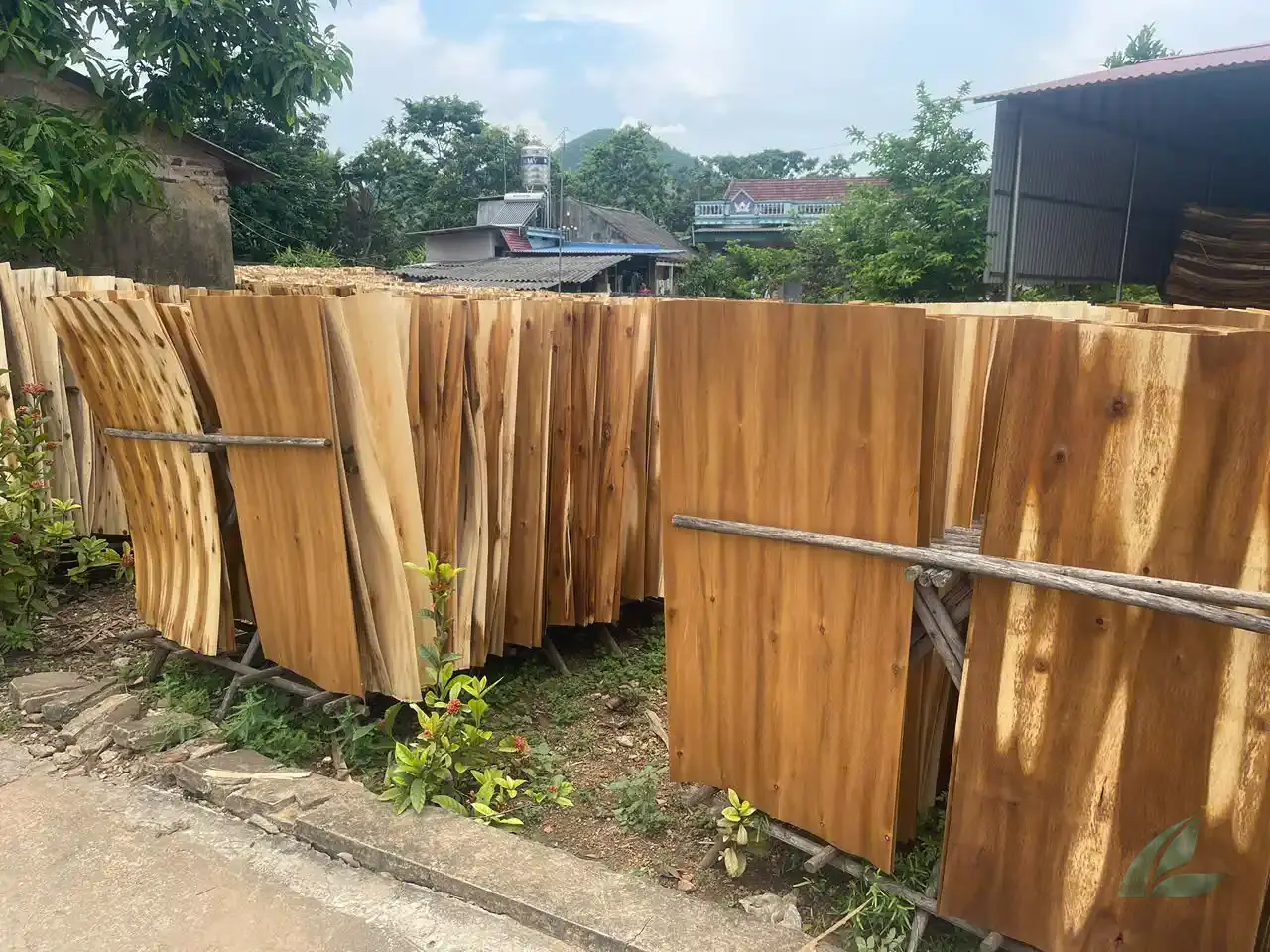
Acacia core plywood is a structural panel where all inner veneer layers are rotary-peeled from Acacia mangium — a fast-growing plantation species cultivated extensively across Northern Vietnam, particularly in Phu Tho, Tuyen Quang, and Yen Bai provinces.
The face veneer applied over the acacia core is a separate decision: bintangor, film, anti-slip, poplar, or unfaced (matt). The core species determines density, weight, and structural behavior. The face species determines surface appearance and suitability for the end application.
Key Insight: Acacia core density is approximately 580 kg/m³ — making it the middle-weight Vietnamese core. Styrax runs lighter at 480–500 kg/m³; eucalyptus runs heavier at 650–750 kg/m³. (HCPLY production data, 2026)
Three core species are produced commercially in Vietnam for export plywood: acacia, eucalyptus, and styrax. Acacia dominates the commercial and packing segment for one reason: price. Plantation acacia matures in 5–7 years and is abundantly available, keeping raw material costs consistently below eucalyptus.
📊 Acacia Core — Technical Specifications
The following specifications reflect factory-produced acacia core plywood from HCPLY’s commercial and packing production facility:
| Parameter | Acacia Core Value |
|---|---|
| Core species | Acacia mangium (plantation VN) |
| Core density | ~580 kg/m³ |
| Container density (packing) | ~580 kg/CBM |
| Core color | Dark brown to reddish-brown |
| Standard thickness range | 3–40mm |
| Common thicknesses | 9, 12, 15, 18, 21mm |
| Sheet sizes | 1220×2440mm, 1250×2500mm, custom |
| Glue (furniture/commercial) | Melamine (MR) — 12h boiling test |
| Glue (construction/film-faced) | Phenolic (WBP) — 72h boiling test |
| Emission class (commercial) | E1 or E2 |
| Core construction (standard) | Loose-laid or edge-jointed |
| Core construction (premium) | Stitched outer layers + edge-jointed inner |
| Sanding | Not sanded (commercial/packing grade) |
| Pallets per 40HC (1220×2440mm) | 16 pallets |
| CBM per 40HC | ~47.5 CBM |
| Weight per 40HC | ~27.5 MT |
Glue and emission are two separate specifications. Melamine (MR) is a glue type; E1 is an emission standard. A panel can be Melamine-glued at E1 or E2. Always specify both when requesting a quotation.
✅ Where Acacia Core Performs Best
📌 Film-Faced Formwork Plywood
Film-faced plywood for concrete formwork is the single largest application for acacia core in Vietnam. The film surface carries the structural load in formwork — the core’s job is to provide adequate rigidity and density to resist deflection under wet concrete pressure.
Acacia at ~580 kg/m³ delivers sufficient stiffness for standard construction formwork grades. Standard film-faced grades use 120–135 gsm phenolic film (4–10 reuses). When paired with Phenolic (WBP) glue and premium AICA film (180–220 gsm), acacia-core panels achieve 15+ reuse cycles at a price point 15–25% below eucalyptus core equivalents.
⚠️ Important: Budget film-faced plywood using loose-laid acacia core with E2 melamine blend adhesive is a different product. Reuse drops to 4–8 cycles. Always confirm glue specification (Phenolic WBP vs Melamine blend) and film weight when ordering film-faced panels.
Buyers: Construction contractors in Southeast Asia, Middle East, and Africa sourcing cost-effective formwork panels.
📌 Packing and Crating Plywood
Industrial packing plywood — for crates, pallets, packing boxes, and shipping containers — requires structural integrity at the lowest possible price. Acacia core fits this specification precisely. Panels are produced unsanded, with loose-laid core construction, bintangor or poplar face veneer (C/D grade), and MR glue at E2 emission.
The panel must carry mechanical load during transit, not look good. Acacia core’s density gives adequate nail- and staple-holding capacity for standard packing applications.
📌 Commercial Bintangor Plywood
Bintangor-face commercial panels — the most widely traded plywood in Asia and the Middle East — almost always run an acacia core for budget segments. The combination delivers: low unit cost, acceptable surface for shopfitting and partitioning, MR glue for indoor use, and E1 or E2 emission.
For markets like India, Malaysia, the Philippines, and Africa buying commercial bintangor panels for interior fit-outs and general use, acacia core is the standard rather than the exception.
⚠️ Where Acacia Core Falls Short
Dark Color Through Thin Faces
Acacia core is dark brown to reddish-brown. With thin decorative face veneers — bintangor A, okoume, or EV at 0.2–0.4mm thickness — the dark substrate shows through at grading, reducing face-grade consistency.
Furniture factories paying premium for A-grade face veneer generally specify styrax or eucalyptus core for this reason. Styrax core is pale white-beige; eucalyptus is light yellow. Neither bleeds through thin decorative faces.
“The color issue with acacia core only matters when the face is thin and the buyer is grading for high-end furniture. For packing or film-faced, nobody cares about core color — it’s covered before it leaves the factory.” — Lucy, International Sales Manager, HCPLY
Loose-Laid Construction Limits Sanding Tolerance
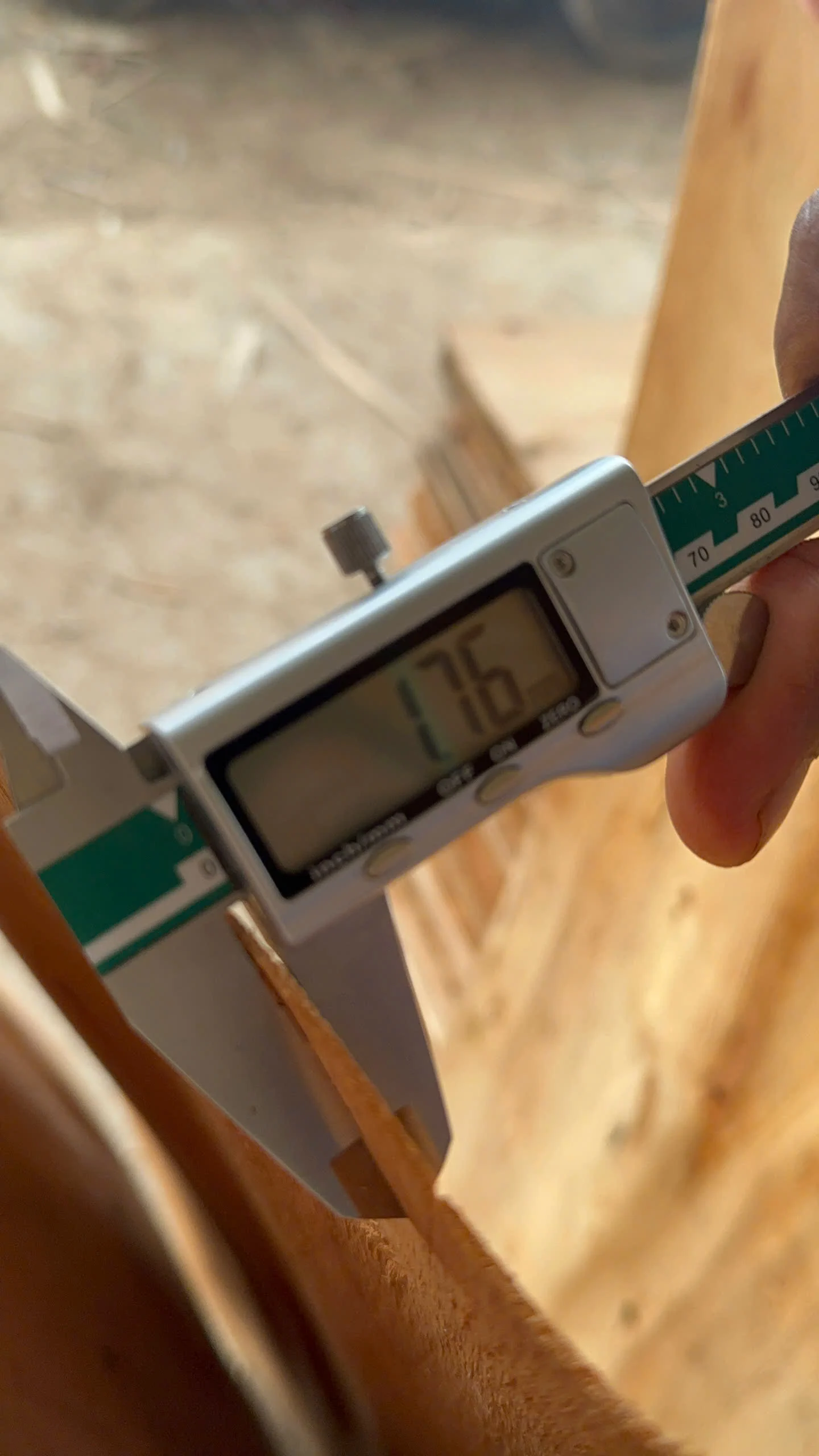
Standard budget acacia panels use loose-laid core construction — veneer pieces are placed manually without stitching. Gaps and overlaps form at piece edges. These small voids reduce surface flatness after pressing, meaning calibration sanding cannot achieve the ±0.3mm thickness tolerance required for premium cabinet-grade panels.
Full-stitched core construction (where every veneer piece is sewn together before pressing) eliminates this problem but adds 10–15% cost. Budget acacia production does not include full stitching. For applications requiring tight thickness tolerance — furniture, cabinets — specify full-stitched styrax or eucalyptus core.
E0 Emission Not Standard
Commercial acacia production in Vietnam typically runs E1 or E2 emission. E0 (≤0.5 mg/L formaldehyde) — required for furniture export to the US (CARB P2 equivalent), Germany, Korea, and Japan — requires low-emission Melamine resin and tighter hot-pressing control. Some acacia production lines achieve E1, but E0 is an upgrade order, not a standard default.
📦 Container Loading — Acacia Core
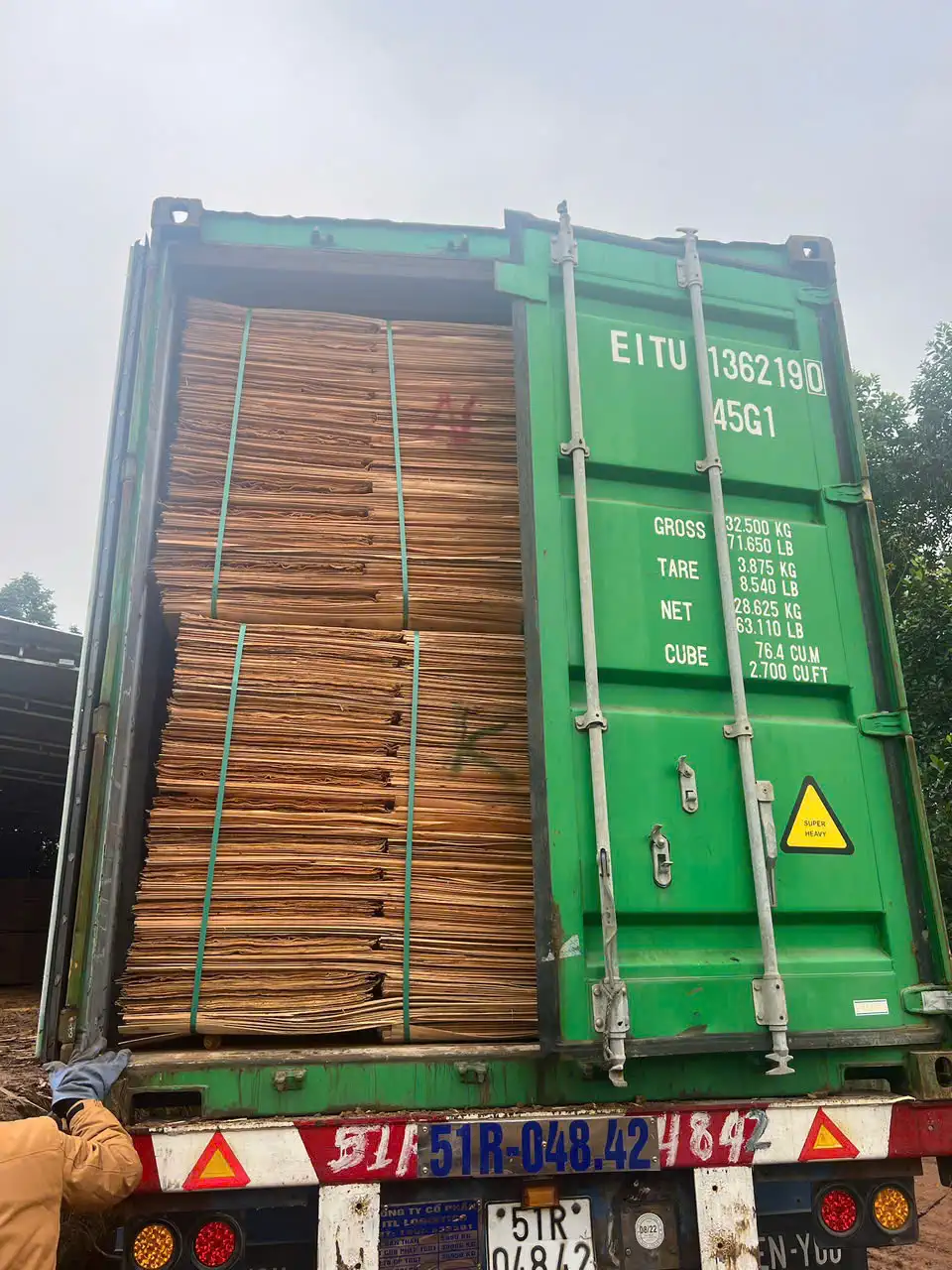
Acacia core plywood (1220×2440mm) loads 16 pallets per 40HC container, producing approximately 47.5 CBM at 27.5 MT total weight (HCPLY container packing data, 2026).
This compares against the other two Vietnamese core species:
| Core | Density (kg/CBM) | Pallets/40HC | CBM | Weight (MT) |
|---|---|---|---|---|
| Styrax | ~500 | 18 | ~53 | ~26.5 |
| Acacia | ~580 | 16 | ~47.5 | ~27.5 |
| Eucalyptus | ~700 | 15 | ~44.5 | ~28 |
Acacia’s mid-density means importers receive more sheets per container than eucalyptus while staying safely below the 28.5 MT payload ceiling. For packing and film-faced buyers optimizing FOB landed cost, 16 pallets of acacia is the standard calculation starting point.
For full packing calculation details including the sheet count formula and how to calculate CBM per container by thickness, see Plywood Container Packing Calculation 2026.
Ready to calculate your acacia core container order? Request a Factory Packing Table from HCPLY — no commitment, factory-level data, same-day response.
🏭 Core Construction Options for Acacia Plywood
Core construction is as important as core species. Vietnam produces acacia plywood across four construction grades:
| Construction | Quality | Use Case | Cost |
|---|---|---|---|
| Loose-laid | Lowest — gaps & overlaps | Packing, crating | Cheapest |
| Finger-jointed | Medium — joints but no gaps | Budget commercial | Mid |
| Stitched outer + edge-jointed inner | Good — stable, few gaps | Commercial furniture | Mid-high |
| Full stitched all layers | Best — no gaps, no overlaps | Premium, tight tolerance | +10–15% |
For packing plywood and standard film-faced formwork, loose-laid acacia is the accepted norm. The application doesn’t require sanding or tight thickness tolerance, so construction gaps are irrelevant.
For commercial bintangor panels being sold into furniture or shopfitting markets, stitched outer layers with edge-jointed inner is the minimum specification worth paying for. Full stitching on acacia core adds cost that only makes sense for premium commercial applications.
Understanding core construction is one of the key decisions in ordering Vietnamese plywood. The comprehensive Plywood Core Types Guide — Acacia vs Eucalyptus vs Styrax covers all three species with a full comparison including density, applications, and ordering recommendations.
🔧 Glue & Emission Specification for Acacia Core
Two parameters define the bonding system of any plywood panel. They are separate specifications:
Glue type (water resistance):
- Melamine (MR) — 12h boiling test. For indoor commercial and furniture use.
- Phenolic (WBP) — 72h boiling test. For construction, marine, film-faced panels.
Emission class (formaldehyde release):
- E2 — ≤5.0 mg/L. Budget grade, outdoor or industrial use. NOT for EU or US interior furniture.
- E1 — ≤1.5 mg/L. Standard indoor grade, acceptable for most Asian and European commercial markets.
- E0 / CARB P2 — ≤0.5 mg/L. Required for US furniture, EU premium, Japan, Korea.
Standard acacia commercial panels ship with Melamine (MR) glue at E1 or E2 emission. Film-faced formwork panels use Phenolic (WBP) glue — emission class is not typically specified for construction applications.
If your market requires E0, specify it explicitly at order stage. E0 on acacia core is possible but requires low-emission resin and premium production controls — always confirm availability and lead time.
For a complete breakdown of glue and emission standards, read Plywood Glue Types & Emission Standards Guide.
📐 Ordering Acacia Core Plywood — Checklist
When requesting a quotation for acacia core plywood from Vietnam, provide the following specifications to avoid misquotation:
- Face veneer: Bintangor / Film / Anti-slip / Poplar / Unfaced (matt)
- Core species: Acacia (confirm — not mixed hardwood)
- Core construction: Loose-laid / Edge-jointed / Stitched outer
- Thickness: 9 / 12 / 15 / 18 / 21mm (specify exact)
- Sheet size: 1220×2440mm or 1250×2500mm
- Glue: Melamine (MR) or Phenolic (WBP)
- Emission: E2 / E1 / E0 (specify your market requirement)
- Quantity: Number of 40HC containers or CBM
- Certifications required: FSC / CARB P2 / CE / EUDR
Without core construction specification, suppliers default to the cheapest option. The difference between loose-laid and stitched outer is not visible in a photo — but it shows up in thickness measurement and surface flatness at the factory.
Get a factory-direct quotation with full specification confirmation: Contact HCPLY Now — HCPLY manages 3 specialized production facilities including a dedicated commercial and packing facility producing acacia core plywood.
🌐 Which Export Markets Use Acacia Core Plywood?
Acacia core panels dominate specific market segments by application:
| Market | Application | Grade |
|---|---|---|
| India | Commercial bintangor panels | MR, E1 |
| Southeast Asia (Philippines, Malaysia) | Packing and crating | MR, E2 |
| Middle East (UAE, Saudi) | Film-faced formwork | WBP, construction |
| Africa (Nigeria, Kenya) | Budget film-faced, commercial | MR/WBP, E2 |
| Korea (low segment) | Film-faced formwork | WBP |
Markets with strict indoor emission requirements — Europe (E0/E1 mandatory for furniture), US (CARB P2 mandatory) — typically specify styrax or eucalyptus core panels for furniture, and eucalyptus core for construction. Acacia core enters these markets primarily through film-faced construction panels where emission class is not the governing specification.
Vietnam exported over 3 million m³ of plywood in 2024, with commercial and packing segments accounting for a substantial portion of that volume (Vietnam Timber & Forest Products Association — VIFORES, 2024). Acacia-core panels represent the cost-efficient backbone of this export volume.
🏭 HCPLY Acacia Core Production
HCPLY manages a dedicated commercial and packing production facility that produces acacia core plywood as its primary output. This facility operates separately from HCPLY’s premium furniture facility (styrax/eucalyptus, E0, full stitched) and its film-faced construction facility.
Production specifications from the commercial facility:
- Core species: Acacia (Acacia mangium, Northern Vietnam plantation)
- Core construction: Loose-laid standard; stitched outer available on request
- Glue: Melamine (MR) standard; Phenolic (WBP) for film-faced
- Emission: E2 standard; E1 available; E0 requires advance confirmation
- Sanding: Not sanded (commercial and packing grade)
- Face veneer options: Bintangor, poplar, film, anti-slip, pine, unfaced (matt)
- Export documents: CO, Phytosanitary, Fumigation Certificate, Invoice, Packing List, B/L
MOQ: 1 × 40HC container. Lead time: 15–20 days from order confirmation.
❓ Frequently Asked Questions
Is acacia core the same as “mixed tropical hardwood core”?
No. Acacia core means exclusively Acacia mangium veneer layers. “Mixed tropical hardwood” is an unspecified blend that may include lower-grade species. When ordering from Vietnam, specify “acacia core” explicitly and request that the supplier confirm species identity on the packing list.
Can acacia core plywood be FSC certified?
Yes. Plantation acacia in Northern Vietnam is FSC-eligible. HCPLY holds FSC Chain-of-Custody certification. FSC-certified acacia core is available on request for markets requiring chain-of-custody documentation — typically Europe, Australia, and North America.
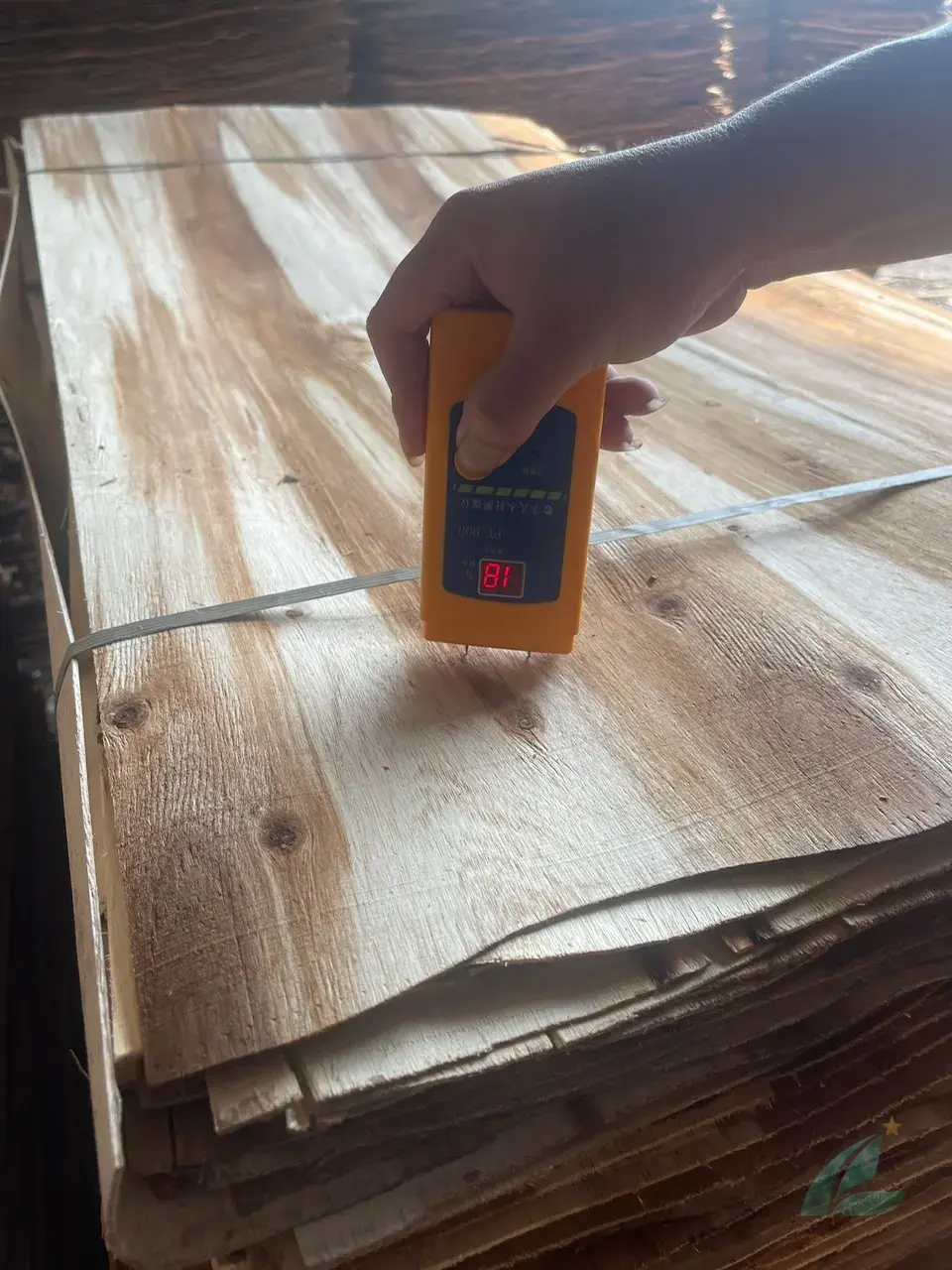
Why is the container loading figure 580 kg/CBM when the wood density is ~580 kg/m³?
The 580 kg/CBM figure is the effective container loading density, which accounts for how sheets pack together in pallets — including air gaps between stacked sheets, pallet frame weight, and packing material. The 580 kg/m³ is the physical density of the acacia wood itself. For pricing, use wood density; for container loading calculations, use the effective packing density.
📋 Conclusion
Acacia core plywood is not a compromise — it is the correct specification for film-faced formwork, packing, and budget commercial panels where density performance at competitive price is the deciding factor.
The key is ordering correctly: specify core construction (not just species), confirm glue and emission class separately, and match the specification to the application. An acacia panel built for packing is a different product from an acacia panel built for commercial furniture — even if the product name looks the same on a quotation.
HCPLY produces both. The right spec for your application is a single conversation away.
Request Acacia Core Plywood Pricing from HCPLY — factory-direct, no VAT, 15–20 day lead time.
Or explore how acacia compares to the other two Vietnamese core species: Plywood Core Types — Acacia vs Eucalyptus vs Styrax.